


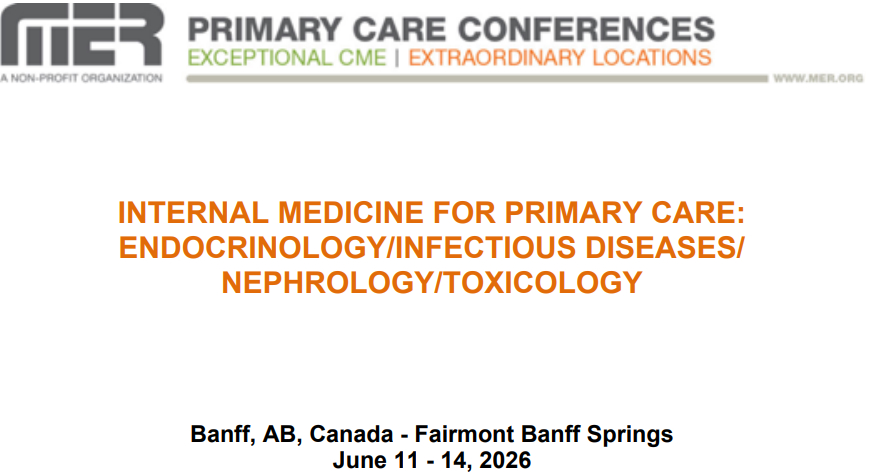
MER Primary Care Conferences Internal Medicine for Primary Care Endo ID Nephro Tox Jun 11-14, 2026
120 $
Format : videos + file sub vtt, size: GB
1. Overview
This is a primary care medical conference organized by Medical Education Resources (MER), a non-profit organization. The conference is titled “Internal Medicine for Primary Care: Endocrinology/Infectious Diseases/Nephrology/Toxicology”. It will be held from June 11-14, 2026, at the Fairmont Banff Springs in Banff, AB, Canada.
2. Learning Objectives
Upon completion of this program, participants should be better able to:
Identify the risks of abnormal thyroid function.
Describe the diagnostic evaluation of thyroid nodules with a focus on the utilization of ultrasound and cytology.
Describe treatment options for pituitary disorders.
List management strategies of adrenal hyper and hypofunction.
Review epidemiology and microbiology of skin and soft tissue infections (SSTI).
List common causative pathogens for various respiratory tract infections.
Evaluate the severity of diarrhea and evaluate the need for treatment.
List goals of an antimicrobial stewardship program and strategies for antimicrobial treatment.
List the classic 5 toxidromes and describe how to approach the poisoned patient.
Describe presentations of cocaine and heroin abuse.
List non-regulated agents of abuse in adolescents and adults and discuss their consequences.
Identify the key characteristics and effects of synthetic drugs, most notably synthetic cannabinoids and synthetic cathinones.
Describe evidence-based guidelines for the use of SGLT2 inhibitors in patients with CKD.
Describe treatment options for hematuria and glomerulonephritis.
Identify strategies to detect and treat diabetic kidney disease.
Review the pathophysiology, diagnosis, prevention and management of common electrolyte imbalances.
3. Target Audience
This program is targeted to office-based primary care providers and other health professionals with updates in primary care medicine.
Best for internists, primary care physicians, endocrinologists, infectious disease specialists, nephrologists, and toxicologists.
4. Topics
Thursday, June 11, 2026
Endocrinology – Disorders of Thyroid Function: Prevalence, diagnosis and treatment options of hypothyroidism and hyperthyroidism.
Endocrinology – Thyroid Nodules and Cancer: Diagnosis and treatment.
Endocrinology – Evaluation and Management of Pituitary Disease: Diagnosis and treatment of pituitary disorders.
Infectious Diseases – Skin & Soft Tissue Infections: Presentation on important skin and soft-tissue infections and their prompt recognition, emphasizing evaluation and management strategies.
Infectious Diseases – Respiratory Tract Infections: Discussion highlighting critical points regarding the diagnosis and management of pneumonia and bronchitis – with a focus on the impact of multidrug resistant pathogens.
Friday, June 12, 2026
Infectious Diseases – Gastrointestinal Infections & Clostridiodes Difficile: Presentation on important enteric pathogens and their recognition, diagnosis and management; special emphasis on clostridiodes difficile colitis and related updates from the ID and infection control literature.
Infectious Diseases – Antimicrobial Stewardship and Multidrug Resistance: Definition of an antimicrobial stewardship program (ASP); Concepts of the antimicrobial stewardship program; Four goals of antimicrobial stewardship; Most recent additions to the antimicrobial armamentarium.
Endocrinology – Adrenal Disorders in Primary Care: Evaluation and management of adrenal hyper and hypofunction; Endocrine hypertension.
Toxicology – An Office-Based Toxicology Overview: Introduction to the workup of the toxic patient; Obtaining an adequate history and physical exam prior to calling poison control; Review of the classic five toxidromes including: cholinergic, anticholinergic, opiate, hypnosedative, and sympathomimetic; The more common toxic ingestions seen in the ED.
Toxicology – Cocaine and Heroin Abuse from an ER Provider’s Perspective: The basics of cocaine and heroin intoxication in the acute care setting; The mechanisms of action and signs and symptoms of acute intoxication; The acute phenomena of cocaine induced chest pain, hypertensive emergency, aortic dissection, pneumonitis and placental abruption; Review of the history of heroin abuse in the US, the cutting agents and adulterants being added to heroin and some of the more esoteric sequelae of chronic opiate abuse.
Saturday, June 13, 2026
Toxicology – The Danger of “Legal Highs” in Both Adolescents and Adults: Inhalant abuse and legal highs and drugs of abuse not yet scheduled by the DEA; Intoxicating inhalants that are ubiquitous in many households and easily accessed by adolescents; Dextromethorphan abuse and the unique psychoactive plants salvia divinorum, kratom, morning glory (LSA) and Jimsonweed; Mechanisms of action, signs and symptoms of intoxication and treatment.
Toxicology – Primary Care Update on Synthetic Drugs: History of synthetic drugs of abuse in the US and EU; Synthetic drugs that mimic the effects of marijuana, stimulants, opiates, and hallucinogens; Synthetic cannabinoids (K2-Spice), novel stimulants (Bath Salts, Flakka), and novel hallucinogens (Molly, Benzofury).
Nephrology – Should All Patients with CKD be on SGLT2 Inhibitors?: Sodium-glucose transporter 2 inhibitors (SGLT2i) represent a major advance in the treatment of patients with diabetes in kidney disease when added onto renin-angiotensin system blocking drugs. Increasing evidence indicates that this class of drugs provides both kidney and cardiovascular benefits to patients with chronic kidney disease, regardless of diabetes status. Primary care providers need to know which patients should be prescribed these drugs as they clearly not only reduce morbidity but also mortality in CKD patients with or without diabetes. This lecture will provide the most up to date use of SGLT2i in patients with CKD, including evidence-based guidelines/goal directed medical therapy.
Nephrology – Glomerulonephritis 101: Glomerulonephritis is an important cause of chronic progressive kidney disease and can be difficult to detect and diagnose. This case based lecture will provide primary care providers with the knowledge and tools on when to suspect glomerulonephritis, how to differentiate from other causes of kidney disease. IgA nephrology, the most common cause of glomerulonephritis, will be discussed as an example of differentiating glomerulonephritides and participants will learn about the mechanisms of action and how to prescribe three FDA approved treatments for patients with this particular glomerular disease.
Sunday, June 14, 2026
Nephrology – Managing Diabetic Kidney Disease: New Insights and Therapies: Chronic kidney disease attributed to diabetes is the leading cause of kidney failure globally. The disease is incurable and kidney disease once established typically progresses and is associated with excessive morbidity and mortality. This presentation will provide up to date information on how to detect, diagnose and manage chronic kidney disease and review recently completed and ongoing clinical trials designed to improve kidney outcomes. The lecture will also discuss when and how to use non-steroidal mineralocorticoid receptor antagonists and Glucagon-like peptide-1 (GLP-1) agonists in clinical practice.
Nephrology – Primary Care Primer on Electrolytes: Electrolyte and acid-base disorders are common findings in clinical practice. They can arise from genetic and acquired diseases and can be associated with commonly prescribed medications. This case-based lecture focuses on the disturbances in and interactions between serum sodium, potassium, and bicarbonate. It reviews the pathophysiology, diagnosis and management of these common imbalances.
Be the first to review “MER Primary Care Conferences Internal Medicine for Primary Care Endo ID Nephro Tox Jun 11-14, 2026”
You must be logged in to post a review.
Related products




Reviews
There are no reviews yet.