


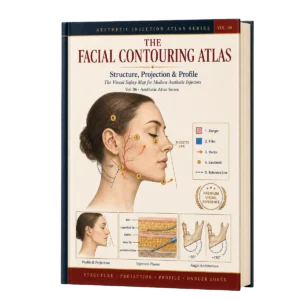
The Facial Contouring Atlas: Structure, Projection & Profile, Aesthetic Injection Atlas Series, Vol. 06 (PDF)
6 $
Format Publisher PDF
File size : 135.2 MB
Publisher : Publisher
Published year : 2000
Aesthetic Atlas · Contour Vol. · New release
The Facial Contouring Atlas. Structure, Projection & Profile
A 58-page visual reference that answers one decision per page: where the contour is read, which vessel is marked first, which plane the product belongs in, and how much goes at each point.
Seven contour regions — cheek, tear-trough, jaw, chin, temple, nose and subtraction
Six named danger structures, each mapped before its technique
Dose-per-point maps, needle and cannula, male and female protocols
Master dosing & instrument table — one page to keep beside the tray
The contour read
Not seven isolated areas — one connected face.
The atlas starts before the treatment choice. Structure asks what holds the face up, projection asks where forward volume belongs, and profile asks how the side view reads. Every later part returns to the same three questions.
Inside the atlas
Ad-clear at a glance. Clinic-precise on the page.
Each major decision is shown as a map, a comparison or a labelled plate — with the numbers on the page, not in a paragraph.
Part 2 · Cheek & Zygoma
The safe zone, and the artery that defines it.
The transverse facial artery runs along the lower edge of the zygomatic arch, which makes that edge the least forgiving line in the cheek. The atlas draws the corridor 1–1.5 cm above it and shows which part of the frame carries product.
Part 2 · Dose logic
Dose per point, not dose ranges.
Where the volume goes along the frame: 0.3 ml at the central lifting point, 0.2 ml at McGregor’s point and the depression, 0.1 ml at the lateral and finishing points. A baseline of 1 ml per side, and where the ceiling sits.
Part 4 · Jawline & Angle
90° or 110° — the angle you build is the result.
Recreating an angle near 90° masculinises; opening toward 110° feminises. The protractor page puts both on one card with the consequences attached: denser male skin, roughly twice the volume, and the angle formed 1 cm above the mandibular edge.
Part 7 · Non-surgical rhinoplasty
Thirty seconds, tip fixed, every time.
The nasal mid-line is the highest-risk corridor in the book, so it gets its own discipline page: locate the axis, fix the hand, aspirate for thirty seconds before every bolus, and repeat the test at each one. The lateral walls are not the working field.
Nine parts · fifty-eight pages
The whole contour, mapped region by region.
One visual system runs from the first read of the face through to the synthesis pages — with every part’s page range on the card.
Be the first to review “The Facial Contouring Atlas: Structure, Projection & Profile, Aesthetic Injection Atlas Series, Vol. 06 (PDF)”
You must be logged in to post a review.
Related products





Reviews
There are no reviews yet.