

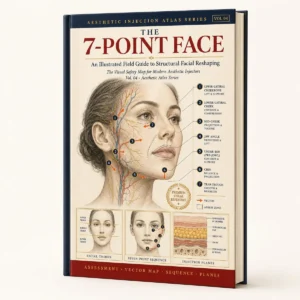
The 7-point face: An Illustrated Field Guide to Structural Facial Reshaping, Aesthetic Injection Atlas Series, Vol. 04 (PDF)
6 $
Format Publisher PDF
File size : 93 MB
Publisher : Publisher
Published year : 2000
Premium Visual Atlas · The Assessment Atlas · New Release
THE 7-POINT FACE
An Illustrated Field Guide to Structural Facial Reshaping
Read the face, then reshape it. A 40-page assessment-and-planning system for aesthetic injectors: the structured facial read, the seven-point vector map, the treatment sequence, and the injection planes that make a result look structural — not merely filled.
The full facial read — thirds, beauty anchors, ranked negatives, the smile test
The 7-point vector map — seven structural points, two refinement zones, one plan
Sequence discipline — foundation → midface → control, in the order that works
Planes & technique — the plane cross-section, needle vs cannula, one-syringe distribution
Instant access · Read before the consult, plan chairside
The missing planning layer
Technique is regional.
The face is not.
A cheek, a chin, or a jawline can each be treated correctly in isolation — and still produce an incoherent whole-face result. This atlas is the layer that decides what belongs in the plan before any regional technique begins.
Placement changes the read
Reshape the frame.
Don’t just add fullness.
The same face, treated two ways. The difference isn’t the number of syringes — it’s where the volume sits, and in what order it was placed.
Inside the atlas
Ad-clear at a glance. Clinic-precise on the page.
01 —The 7-Point Vector Map
The anchor figure the whole book expands. Seven numbered landmark dots, each with its direction of effect — up-out, inward, forward, back-down — plus two dashed refinement zones, deferred by design. The dots are landmarks, the arrows are directions, and the numbering is the read order — Part 4 sets the treatment order.
Key insightThe map is overview by design. It tells you where and why; the regional atlas tells you exactly how deep and how much.
02 —The Read That Builds the PlanFacial thirds and which third dominates. Beauty anchors and the masculine / feminine read. The ranked-negatives discipline — assess the negative first and stop at three. The mirror-then-photo consult, the emotional-attribute menu that turns “tired” and “heavy” into regions, and the smile test that decides whether a result survives movement.
Key insightA result that survives the smile is a real result. Test movement before you commit the plan.
03 —Sequence DisciplineOrder of operations — structure first. The “ping-pong ball” error and why lateral vectors come before anterior ones. The chin sequence — slim → lengthen → project — and the full-face order: foundation → midface → control.
Key insightThe sequence is the product. The same seven vectors, placed out of order, do not give the same face.
04 —The Injection-Plane Cross-SectionOne labelled cross-section, referenced across the book: dermis to periosteum, with the safe plane in green and the layers that decide both the result and the risk. Then needle vs cannula, plane by plane — decide the plane first, and let it choose the device.
Key insightDecide the plane first, then the device. Depth is a decision, not an accident.
05 —One Syringe, Distributed with Intent
Match rheology to the job — robust, high-projection classes for deep structure; softer classes for fine work. Treat dose as a range with a floor and a ceiling, and make a single syringe do structural work by distributing it deliberately across a vector.
Key insightThe effective dose range has a floor and a ceiling — the floor protects longevity, the ceiling protects safety.
Be the first to review “The 7-point face: An Illustrated Field Guide to Structural Facial Reshaping, Aesthetic Injection Atlas Series, Vol. 04 (PDF)”
You must be logged in to post a review.
Related products




Reviews
There are no reviews yet.