

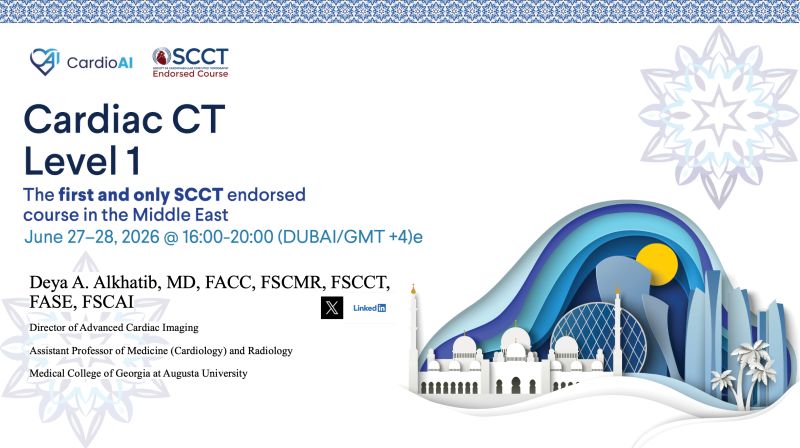
Society of Cardiovascular Computed Tomography The Cardio AI Imaging CT Course in the UAE Level 1 June 27 – 28, 2026
30 $
Format : videos + file sub vtt, size: GB
The Society of Cardiovascular Computed Tomography (SCCT) “The Cardio AI Imaging CT Course in the UAE Level 1” (June 27 – 28, 2026) is a comprehensive foundational program designed to introduce medical professionals to the principles and clinical applications of Cardiovascular Computed Tomography (CCT). This specialized edition held in the UAE uniquely integrates cutting-edge Artificial Intelligence (AI) technologies into standard cardiac imaging workflows. Over the two-day intensive program, attendees will receive didactic lectures and hands-on workstation training covering scanner technology, patient preparation, radiation safety, anatomy, and disease pathology, culminating in the foundational knowledge required for SCCT Level 1 certification.
Learning Objectives
Understand fundamental principles: Master the physical principles, technical specifications, and scanner operations required for optimal Cardiovascular CT acquisition.
Master scan protocols: Apply standard patient preparation protocols, including ECG gating, heart rate control (beta-blockers), and contrast media administration.
Identify anatomy: Accurately identify normal cardiac and coronary anatomy, as well as common congenital anomalies and anatomical variants.
Assess pathology: Apply standard grading systems (such as CAD-RADS) to assess coronary artery disease, plaque morphology, and stenosis severity.
Mitigate artifacts: Recognize and troubleshoot common CT artifacts, including motion, calcium blooming, and beam hardening.
Leverage AI tools: Understand and utilize emerging Artificial Intelligence (AI) and Machine Learning (ML) applications for automated calcium scoring, advanced plaque quantification, and CT-derived Fractional Flow Reserve (FFR-CT).
Achieve certification milestones: Complete the didactic and initial hands-on case-review requirements necessary to pursue SCCT Level 1 verification.
Target Audience
This course is primarily designed for cardiovascular medicine and radiology professionals who are at the beginning of their training in cardiovascular computed tomography. It is highly suitable for fellows, residents, and attending physicians who wish to acquire foundational (Level 1) expertise in CCTA and want to understand how to integrate modern AI-driven imaging tools into daily clinical practice to improve diagnostic accuracy and workflow efficiency.
Best for Cardiologists, Radiologists, Interventional Cardiologists, Structural Heart Specialists, and Cardiovascular Imaging Informaticists.
Topics
Module 1: Foundations of Cardiac CT Physics of CT scanners, principles of temporal and spatial resolution, detector array technologies, radiation physics, and comprehensive radiation dose-reduction strategies.
Module 2: Patient Preparation & Scan Acquisition ECG gating techniques (prospective triggering vs. retrospective gating), heart rate and rhythm control management, indications and contraindications for beta-blockers and nitroglycerin, contrast injection protocols, and timing techniques (bolus tracking vs. test bolus).
Module 3: Cardiac & Coronary Anatomy Detailed cross-sectional anatomy of the heart, normal coronary artery origins and courses, coronary dominance, and identification of significant and malignant coronary anomalies.
Module 4: Artificial Intelligence in Cardiovascular Imaging Core principles of AI and Machine Learning in CT, deep-learning based image reconstruction (DLIR), AI-driven automated Agatston calcium scoring, automated coronary tree extraction, AI plaque characterization/quantification, and the clinical principles of CT-derived Fractional Flow Reserve (FFR-CT).
Module 5: Coronary Artery Disease Interpretation Pathophysiology of atherosclerosis on CT, grading of coronary stenosis, structured reporting using the CAD-RADS 2.0 system, and the basic evaluation of coronary stents and bypass grafts.
Module 6: Non-Coronary and Structural Heart CT Evaluation of cardiac morphology, basic valvular assessment, CT planning for Transcatheter Aortic Valve Replacement (TAVR/TAVI), pulmonary vein mapping for electrophysiology procedures, and the identification of cardiac masses and thrombi.
Module 7: Artifact Recognition and Troubleshooting Identification, prevention, and software-correction of motion artifacts, breathing artifacts, arrhythmias, beam hardening, and calcium blooming.
Module 8: Hands-on Workstation Training Supervised, interactive case reviews using advanced post-processing software and AI-integrated platforms. Trainees will review a curated set of standard cases covering normal anatomy, varied CAD pathologies, and artifact management to fulfill SCCT Level 1 initial case requirements.
Be the first to review “Society of Cardiovascular Computed Tomography The Cardio AI Imaging CT Course in the UAE Level 1 June 27 – 28, 2026”
You must be logged in to post a review.
Related products





Reviews
There are no reviews yet.