

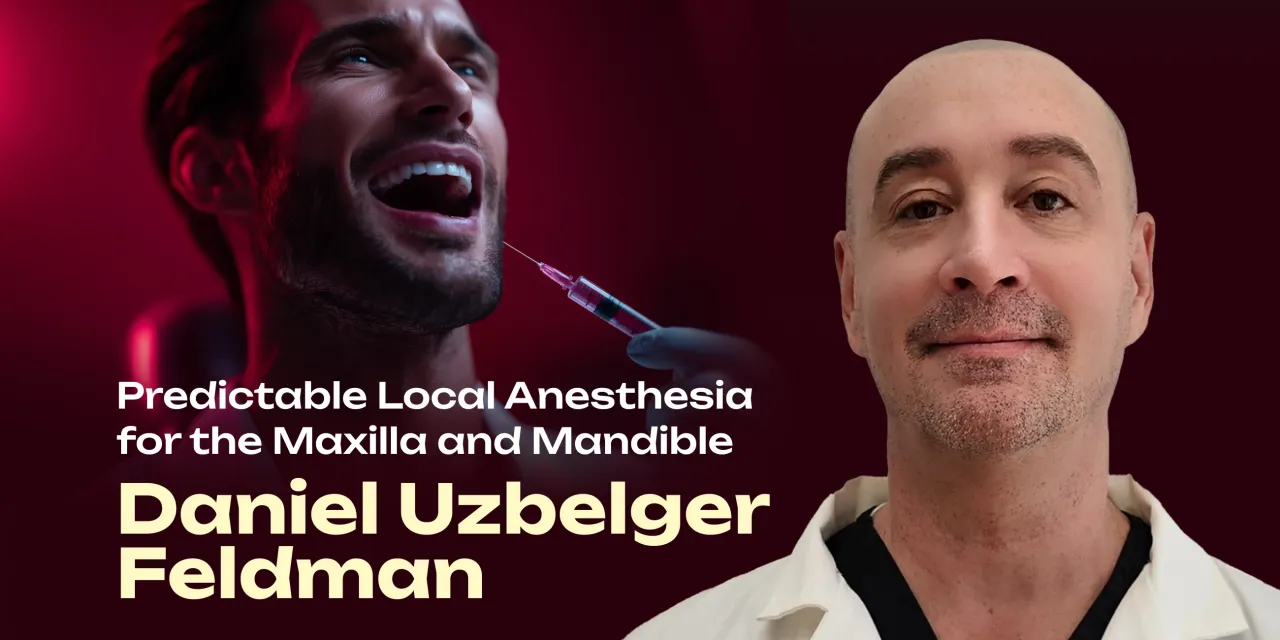
OHI-S Predictable Local Anesthesia for the Maxilla and Mandible 7 lessons 4h 19min
45 $
Format : Videos + PDF
Despite correct technique and appropriate dosing, achieving consistent and profound local anesthesia remains one of the most unpredictable aspects of clinical dentistry. Led by Daniel Uzbelger Feldman, this comprehensive clinical course transforms uncertainty into predictability through a deep understanding of pain science, neuroanatomy, and evidence-based injection protocols for the maxilla and mandible.
Learning Objectives
Apply evidence-based maxillary nerve anesthesia protocols.
Execute predictable inferior alveolar nerve block protocols.
Implement painless injection strategies for single and multiple teeth.
Master the Intraoral Cervical Plexus Anesthetic Technique (ICPAT).
Utilize clinical strategies to eliminate the need for supplemental injections.
Target Audience
This course is designed for dental practitioners who face the clinical challenge of failed anesthesia and seek to achieve profound, consistent pain control using advanced neuroanatomical techniques.
Best for General Dentists, Endodontists, Oral and Maxillofacial Surgeons, and Periodontists.
Topics
Lesson 1. Foundations of Dental Anesthesia and Pain Perception
Foundations of dental anesthesia
What patients actually feel during injections
Sequence of events during injection: Needle insertion, Temperature change, Chemical irritation at the needle tip, Pressure and tissue distension, Central amplification
Conceptual mechanisms of anesthesia
Evolution of dental structures and C- and A-delta fibers
Evolution and history of dental anesthesia
Overview of local anesthetic types and formulations
Lesson 2. Mechanisms of action and Limitations of Dental Anesthesia
Mechanisms of action: sodium channel blockade, nerve fibers, and conduction physiology
What pharmacology cannot explain
Pain science: perception, modulation, body language, and myths
Setting the stage: why dentistry presents unique challenges compared to medicine
Lesson 3. Maxillary Anesthesia: Anatomy, Variability, and Painless Clinical Protocols
Anatomy of the trigeminal nerve: origin and pathway
Anatomy of the maxillary nerve: origin and pathway
Nerve structure and pathways
Fascicles: nerve comparison and paresthesia
Diffusion of local anesthetic in the maxilla
Primary maxillary techniques
Maxillary anesthetic variability
Why buccal infiltration alone often fails in molars
Why infraorbital anesthesia matters
How to eliminate pain when delivering palatal techniques
Protocols for integrating the palatal root without palatal injections
Needle insertion protocols
Protocols for painless maxillary anesthesia
Lesson 4. Predictable Maxillary Anesthesia: Techniques for 100% Success
Painless maxillary anesthetic technique for a single tooth
Needle insertion and topical anesthetic application
Pressure and tissue distension
Protocols for painless maxillary anesthesia for multiple teeth
Painless anesthesia: single tooth vs multiple teeth
Dosage awareness and toxicity
Dose awareness: technique calculation
Anesthetic selection for different clinical scenarios
Lesson 5. Mandibular Anesthesia Failure: Limitations, Anatomy, and Clinical Challenges
Limitations of mandibular anesthesia
Anatomical variations of the mandible
Inferior alveolar nerve considerations
Failure of conventional mandibular anesthesia
The real problem: 35 million failed mandibular blocks per year in the U.S.
Lesson 6. Predictable Mandibular Anesthesia: Intraoral Cervical Plexus Technique
ICPAT: Intraoral Cervical Plexus Anesthetic Technique. Dr. Uzbelger’s published technique
Results from clinical trials and validation studies
How to eliminate intraligamentary, intraosseous, and intrapulpal injections
Anatomical exploration of mandibular anesthesia
Anatomical analysis of mandibular innervation
Evidence for accessory innervation: historical, modern, and Dr. Uzbelger’s studies
Sihler’s staining and cadaveric findings: the cervical plexus reaches the mandible
The first anatomical proof of the accessory innervation pathway
Step-by-step video demonstration of the Intraoral Cervical Plexus Anesthetic Technique
Step-by-step protocols of accessory innervation technique protocols (AITP)
Lesson 7. The Future of Dental Local Anesthesia: Innovation, Technology, and New Formulations
The role of anatomy-driven anesthesia in modern dentistry
Warm, buffered, or electronic delivery systems
New formulations: will we evolve?
How dentistry can finally eliminate fear by achieving predictable anesthesia
A new paradigm: shifting from reactive failure management to preemptive anatomical control
Integrating technology: ultrasound guidance, imaging, and AI assistance
Be the first to review “OHI-S Predictable Local Anesthesia for the Maxilla and Mandible 7 lessons 4h 19min”
You must be logged in to post a review.
Related products


Reviews
There are no reviews yet.