

-
×
 ITI International Team for Implantology Webinar & Video Lectures Package Part-2
1 × 50 $
ITI International Team for Implantology Webinar & Video Lectures Package Part-2
1 × 50 $ -
×
 Esthetic Rehabilitation: Esthetic and Functional Integration of the Prosthetic Rehabilitation (CME VIDEOS)
1 × 60 $
Esthetic Rehabilitation: Esthetic and Functional Integration of the Prosthetic Rehabilitation (CME VIDEOS)
1 × 60 $ -
×
 Decision Making for Retreatment of Failures in Dental Medicine
1 × 45 $
Decision Making for Retreatment of Failures in Dental Medicine
1 × 45 $ -
×
 Netter's Dissection Video Modules (Complete HTML)
1 × 80 $
Netter's Dissection Video Modules (Complete HTML)
1 × 80 $ -
×
 Non-Invasive and Additive Prosthodontics Restorations (CME VIDEOS)
1 × 60 $
Non-Invasive and Additive Prosthodontics Restorations (CME VIDEOS)
1 × 60 $ -
×
 ITI International Team for Implantology Webinar & Video Lectures Package Part-3
1 × 50 $
ITI International Team for Implantology Webinar & Video Lectures Package Part-3
1 × 50 $
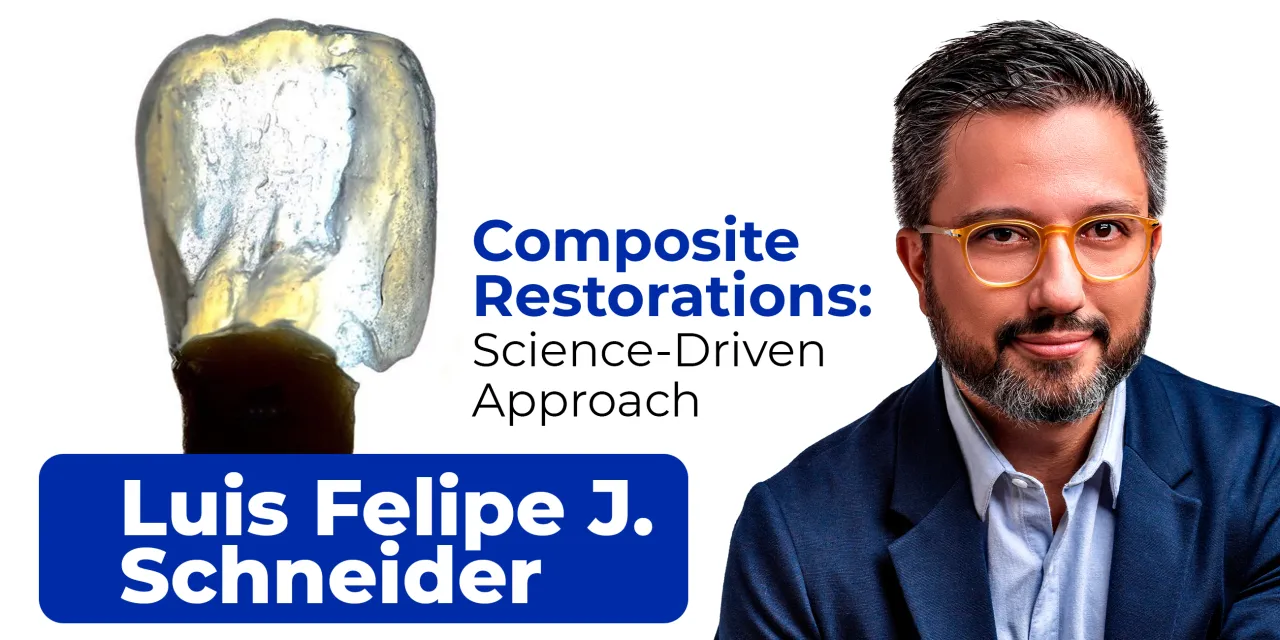
OHI-S Composite Restorations Science-Driven Approach
40 $
Format : 4 videos + 4 audios + 4 file sub vtt, size: 1.03 GB
3 lessons + 1 free (2h 9min)
Master the art of anterior and posterior composite restorations using a science-driven clinical approach!
Dr. Luis Felipe Schneider, a clinician and researcher in the field of dental materials, simplifies the clinical workflow of composite restorations based on a science-driven approach to achieve functional, aesthetic, and long-lasting adhesive composite restorations.
During this course, you will learn in details about:
– Analysis of composite materials available in the dental market
– Classification of composite restorations, indications, and advantages in various clinical cases
– Adhesive protocols to achieve functional and long-lasting restorations
– Analysis of various layering techniques
– Restorative protocols of anterior and posterior teeth from A to Z.
This course will guide you in understanding the most important approach to composite restorations, which is the science-driven clinical approach. After completing this course, you will be confident that your composite restorations will serve your patients for many years to come!
The OHI‑S Composite Restorations: Science‑Driven Approach course is best for restorative dentists, prosthodontists, and general practitioners who want structured, training in evidence‑based composite restoration techniques. It emphasizes the scientific principles behind material properties, adhesive protocols, and clinical workflows to ensure predictable, durable, and aesthetic outcomes.
Who Should Enroll
Restorative dentists & general practitioners performing everyday composite restorations who want to refine their techniques.
Prosthodontists integrating composites into complex restorative and aesthetic cases.
Residents & fellows in restorative dentistry or prosthodontics seeking advanced, science‑based training.
Dental researchers & academics interested in material science and evidence‑based restorative protocols.
Dental hygienists & assistants supporting restorative workflows and patient education.
What You’ll Learn
Material science: properties of composites, polymerization shrinkage, and wear resistance.
Adhesive protocols: bonding strategies for enamel and dentin based on scientific evidence.
Layering techniques: incremental placement to optimize curing and aesthetics.
Clinical protocols: step‑by‑step restorative workflows for anterior and posterior teeth.
Finishing & polishing: methods to achieve natural translucency and long‑lasting gloss.
Case‑based lessons: demonstrations of science‑driven composite restorations in practice.
+ Topics:
Lesson 1.Basic Formulations for All Dental Composites Available in the Market
– Fillers: composition, size and distribution, quantity
– Resin matrix composites:
– Monomers (conventional and self-adhesive)
– Pigments
– Stabilizer.
– The initiator system: photo-initiator systems used in the resin composite composition
– Silane coupling agents and surface conditioning
– Interesting facts about the manufacturing of resin composites.
Recommended for: Restorative dentist, General dentists.
Lesson 2.Classification of Dental Composite Materials and Daily Clinical Questioning
– Particle size of composite: micro vs. hybrid vs. nano
– Composite polymerization activation mode: self-curable, photocurable and dual-curable composites
– Viscosity of composite materials:
– Regular composites
– Flowable composite.
– Clinical application of direct composite
– Clinical application of indirect composite: ceromers, the milling blocks, the printable materials
– Clinical application of composite depending on the target location: anterior restoration, posterior restoration, universal
– The layering technique: incremental vs. Bulk Fill
– Analysis of clinical cases.
Recommended for: Restorative dentist, General dentists.
Lesson 3.Optical and Adhesive Properties for Aesthetic and Durable Composite Restorations
– Optical characteristics of dental composite
– “Vita-based” and “Non-Vita-based” scales
– The opacity level of dental composite
– Application of universal composites
– Application of unichromatic composites
– Classification of dental adhesive material: the one step vs. the two step vs. total etch protocol
– The biological activity of adhesive material
– Proper considerations about dental adhesives in clinical practice
– Analysis of clinical cases.
Recommended for: Restorative dentist, General dentists.
Lesson 4.Aesthetic and Durable Anterior and Posterior Restorations. Clinical Tips and Tricks
– Controlling polymerization shrinkage stress in the dally practice
– Improving marginal sealing. Analysis of clinical cases
– Analysis of various layering techniques and protocols
– Photoactivation: light curing units, techniques and relevant keypoints
– Common clinical questions and answers
– Key points to obtain beautiful and durable direct restorations in the posterior sector
– Key points to obtain beautiful and durable direct restorations in the anterior sector
– Analysis of clinical cases and finishing and polishing protocols.
Recommended for: Restorative dentist, General dentists.
Be the first to review “OHI-S Composite Restorations Science-Driven Approach”
You must be logged in to post a review.
Related products

Dental Ebook And Video
60 $
Dental Ebook And Video
ITI International Team for Implantology Webinar & Video Lectures Package Part-1 (99 Videos)
60 $
Dental Ebook And Video
Extraction Socket – Preservation/Grafting; Immediate vs Delayed Implants; Pontic Site Development
38 $
Dental Ebook And Video
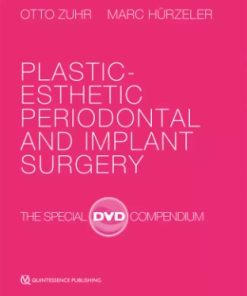
Plastic-Esthetic Periodontal and Implant Surgery: The Special DVD Compendium
39 $
Reviews
There are no reviews yet.