



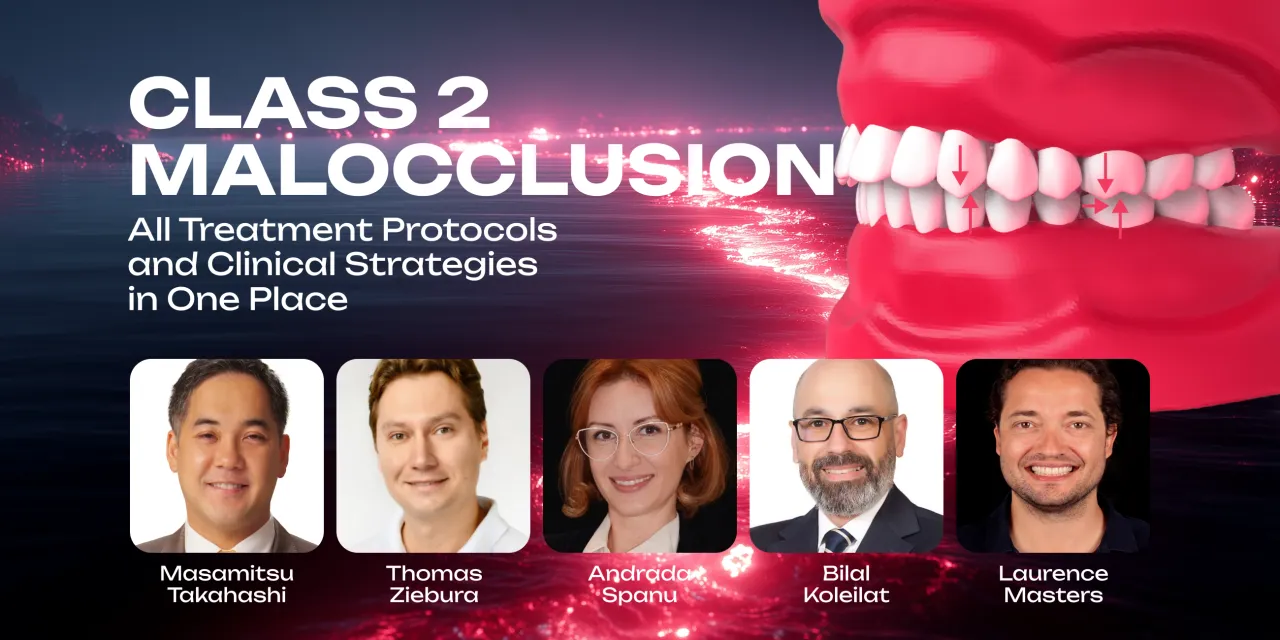
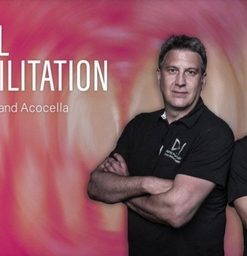
OHI-S Class 2 Malocclusion. All Treatment Protocols and Clinical Strategies in One Place 7 lessons 6h 49min
65 $
Format : Videos + PDF
Class 2 malocclusion is not a single problem — it is a spectrum of skeletal, dental, and vertical discrepancies that demands precision, strategy, and clinical adaptability. This comprehensive program brings together all major treatment philosophies, mechanics, and decision-making frameworks into one unified clinical system. From growth modification in developing patients to camouflage strategies in adults, every phase of Class 2 therapy is dissected through a biomechanics-driven and case-based lens to transform complexity into structured predictability.
Learning Objectives
Utilize diagnostic frameworks for identifying skeletal, dental, and vertical discrepancies.
Implement growth modification strategies during the pubertal growth phase.
Apply camouflage mechanics for adult Class 2 correction.
Manage vertical dimension control and understand its impact on facial aesthetics and stability.
Master the biomechanics of intermaxillary elastics, functional appliances, and fixed appliances.
Execute the clinical application of TADs for anchorage control and complex tooth movements.
Navigate extraction vs non-extraction decision-making in Class 2 cases.
Develop strategies for achieving long-term stability, function, and aesthetic balance.
Target Audience
This course is designed for dental professionals seeking advanced clinical strategies, biomechanics-driven protocols, and decision-making frameworks for managing skeletal, dental, and vertical discrepancies in both growing and non-growing patients. Best for Orthodontists, Pediatric Dentists, and Restorative Dentists.
Topics
Lesson 1. Gummy Smile Management in Class 2 Malocclusion
Diagnosis and assessment of the need for vertical control
Methods of vertical dimension control: advantages and disadvantages
Vertical control of anterior teeth. Improvement or prevention of gummy smile
Treatment approaches for gummy smile correction
Clinical application of high-pull J-hook headgear
Application of 2×4 intrusion arch mechanics
Influence of TAD vertical position on the occlusal plane
Extraction treatment mechanics in Class 2 cases
Lesson 2. Class 2 and Vertical Dimension Control in Orthodontic Treatment
Diagnosis and assessment of the need for vertical control
Influence of TAD vertical positioning on the occlusal plane
Effect of lever arm length on incisor inclination
Relationship between TAD vertical position, lever arm length, incisor inclination, and overbite
Methods for controlling the vertical dimension of occlusion: advantages and disadvantages
Vertical control of the molar region
Difference between intrusion by rotation of occlusal plane applying biomechanics and absolute intrusion
Effect of the vertical position of TADs on the inclination of the occlusal plane
Retention and relapse following vertical dimension control
Lesson 3. Camouflage Treatment of Class 2 Malocclusion: Clinical Protocols
Retraction of upper anterior teeth in Class 2 cases and associated facial profile changes
Functional appliance therapy strategies in growing patients
Protocols for Class 2 correction using intermaxillary elastics
Clinical application and biomechanics of Herbst and Herbst-type appliances
Elastic-supported and hybrid Herbst appliance derivatives
Treatment protocols for Class 2 Division 2 malocclusions
Lesson 4. The Role of TADs in Class 2 Orthodontic Treatment
Protocols for Class 2 correction through molar distalization techniques
Design and customization of distalization mechanics protocols
Posterior anchorage reinforcement strategies and stabilization techniques
En-masse retraction protocols for anterior teeth control
Sagittal correction protocols through molar intrusion mechanics
Lesson 5. Role of CBCT in Class 2 Malocclusion Diagnosis and Treatment Planning
Tooth angulation in relation to the alveolar bone using CBCT
Correlation between CBCT and cephalometric (teleradiographic) analysis
Assessment of bone limitations based on CBCT findings
Extraction vs distalization for camouflage treatment: CBCT-based decision-making process
Root resorption: assessment and implications on CBCT imaging
Finishing phase guided by CBCT evaluation
Temporomandibular disorders (TMD) assessment using CBCT
Lesson 6. Vertical Dimension and Occlusal Plane Control in Class 2 Malocclusion Treatment
Role of vertical dimension and occlusal plane angulation in Class 2 diagnosis and treatment planning
Cephalometric and clinical indicators of vertical excess and deficiency in Class 2 cases
Influence of occlusal plane control on mandibular positioning, facial aesthetics, and long-term stability
Comparison of conventional, skeletal anchorage–assisted, and hybrid vertical control approaches
Biomechanical strategies for vertical dimension control using fixed appliances, aligners, and TADs
Effects of vertical control on soft tissue harmony and smile aesthetics
Case-based applications of occlusal plane modification in Class 2 correction
Integration of vertical control principles in comprehensive treatment planning for adolescent and adult patients
Lesson 7. Simplified Mechanics for the Treatment of Class 2 Malocclusion in Growing and Non-Growing Patients
Etiology of Class 2 malocclusion with emphasis on occlusal plane and mandibular deficiency
Treatment principles in growing vs non-growing patients: diagnostic differentiation and decision-making
Early use of intermaxillary elastics and bite ramps in Class 2 deep bite and open bite cases
Vertical and transverse control strategies in Class 2 correction
Functional appliance therapy during the pubertal growth spurt for skeletal modification
Fixed appliance strategies in non-growing patients: extraction and non-extraction protocols
Use of TADs in severe non-growing Class 2 cases
Simplified biomechanics: reduced wire sequences and non-compliance treatment approaches
Clinical case applications:
Deep bite and severe overjet in growing patients
Deep bite with gummy smile in growing patients
Class 2 subdivision cases in growing patients
Class 2 treatment with premolar extractions in non-growing patients
Class 2 non-extraction treatment with TADs in non-growing patients
Class 2 treatment with extractions and gummy smile correction in non-growing patients
Be the first to review “OHI-S Class 2 Malocclusion. All Treatment Protocols and Clinical Strategies in One Place 7 lessons 6h 49min”
You must be logged in to post a review.
Related products
Reviews
There are no reviews yet.