


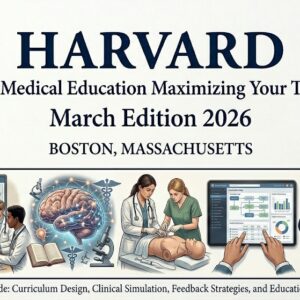
Harvard Principles of Medical Education Maximizing Your Teaching Skills March Edition 2026
150 $
Format :22 Videos (.mp4) + 22 Subtitles (.vtt) + 34 PDFs, size: 5.97 GB
1. Overview
The Harvard Principles of Medical Education Maximizing Your Teaching Skills March Edition 2026 course provides a comprehensive update on modern instructional strategies and curriculum development for clinical faculty. The program focuses on leveraging the science of learning, improving bedside and small group teaching, addressing implicit bias, and navigating emerging technologies like artificial intelligence in the educational landscape.
Course Date: March 2026
Improve the effectiveness of your teaching and mentoring with best practices, new principles of adult learning, and the latest educational technology. This comprehensive exploration of medical education will help you inspire students, residents, fellows, and colleagues at the bedside, in ambulatory settings, and in the classroom.
The Techniques and Strategies That Significantly Improve Student Engagement, and Teaching and Mentoring Effectiveness
Incorporating best practices, newer principles of adult learning, and widely available technologies into your teaching can significantly improve your ability to engage and inspire students, residents, fellows, and colleagues. This special program, ranked among Harvard Medical School’s highest-rated CME courses, is a uniquely comprehensive exploration of best practices for teaching medicine at the bedside, in ambulatory settings, and in the classroom.
The 2026 curriculum helps medical educators to:
Leverage artificial intelligence in your teaching
Provide more effective feedback that motivates change
Utilize active learning strategies in small and large group teaching settings
Deliver more impactful and engaging lectures
Characterize best practices for mentor-mentee relationships and identify ways to leverage mentorship opportunities to help you thrive at work
Optimize evaluation of trainee competencies
Improve engagement and interactivity for in-person and virtual teaching sessions
Enhance critical thinking and self-directed learning among students
Describe real-time strategies to address unprofessional behavior
Identify strengths and weaknesses of various assessment tools
Incorporate various forms of technology, including digital media and artificial intelligence, into your teaching
Create an action plan for implementing and sustaining effective change as leaders in medical education
Identify strategies to recognize and mitigate bias
Describe personal and organizational strategies to improve the well-being of yourself and your trainees
Case-based and hands-on learning are a hallmark of this course, with significant participant interaction and active modeling of instruction techniques. Whether you are newer to teaching or a seasoned educator and mentor, this course will give you modern tools and practices to optimize skills transfer and learner success.
SKILLS DEVELOPMENT
Areas of focus in which attendees will deepen their skills include:
Interactive Lecturing
Bedside Teaching
Effective Mentoring
Impactful Feedback
Developing Curricula
Assessing Learners
Learner Engagement
Teaching Critical Thinking
Teaching and Maintaining Wellness
2. Learning Objectives
Upon completion of this course, participants will be able to:
Identify principles of adult learning in order to:
Assess their learners’ needs,
Design an educational intervention
Establish learner-centered learning environments
Employ venue-specific teaching skills for:
Ambulatory teaching
Bedside teaching
Large-group presentations
Small-group/case-based teaching
Recognize effective learner assessment strategies and provide effective feedback in order to set educational expectations
Foster critical thinking skills so learners may effectively use questions to promote clinical decision-making
Engage in reflective practice in order to identify effective teaching techniques
3. Target Audience
Best for medical educators and clinical faculty who want updates on instructional strategies, curriculum design, and trainee mentorship.
Who Should Participate
Medical personnel of all specialties involved in the practice of medical education, including:
Physicians
Nurse Practitioners
Physician Assistants
Nurses
Pharmacists
Psychologists
Veterinarians
Dentists
4. Topics
01 Effective Teaching Setting the Stage
02 Teaching in the 21st Century Leveraging the Science of Learning
03 Clinical Bedside Teaching Effective Techniques and Overcoming Barriers
04 Teaching Professionalism in 2025 Strategies for the Frontline
05 Defining, Teaching, and Assessing Critical Thinking and Clinical Reasoning
06 Skills and Strategies to Improve Small Group Teaching
07 Strategies to Reduce Implicit Bias
08 Teaching in the Brave New World- Medical Education in the World of AI & other Emerging Technologies
09 Designing and Delivering More Effective Lectures Techniques for Better Learner Engagement
10 Mentoring for the Future Mentoring to Combat Burnout and Attrition
11 Interprofessional Teaching From Parallel Practice to Partnership
12 Assessment of Learning Determining Competence
13 Meeting learners where they practice Bringing simulation to the clinical environment
14 Coaching for Success Supporting Trainee Well-Being and Your Own
15 Curriculum Design Best Practices for Creation, Implementation and Evaluation
16 Feedback Making it Powerful, Effective, and Efficient
17 Leading Effective Change in Medical Education
18 TANGIBLE TAKE HOME – SNAPPS Daniel Ricotta, MD
19 Tangible Take Home Series – Concept Mapping – Practice Jeremy Richards, MD
20 TANGIBLE TAKE HOME – Concept Mapping – Part 1 Richard Schwartzstein, MD
Faculty Introduction Videos
Participants Introduction Videos
Be the first to review “Harvard Principles of Medical Education Maximizing Your Teaching Skills March Edition 2026”
You must be logged in to post a review.
Related products


Reviews
There are no reviews yet.