

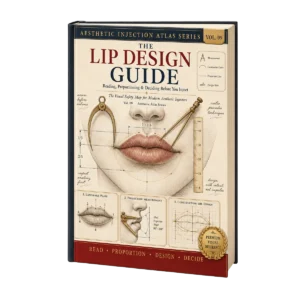
The Lip Design Guide: Reading, Proportioning & Deciding Before You Inject, Aesthetic Injection Atlas Series, Vol. 09 (PDF)
6 $
Format Publisher PDF
File size : 146.8 MB
Publisher : Publisher
Published year : 2026
Vol. 09 · Premium Visual Atlas · New Release
The Lip Design Guide
Reading, Proportioning & Deciding Before You Inject
Stop starting with “how many mLs?” Start with the face. A 68-page illustrated decision guide for injectors who read the face, understand the lip in context, and define the design before choosing how to execute it.
Read facial thirds, symmetry, the cupid’s bow, the six tubercles, and the profile
Work the eight dimensions — motivation and risk through projection, definition and proportion
Distinguish balanced, keyhole and M-shape closure patterns — and design for each
Needle-vs-cannula decision tree · artery safety as a design dimension
Quick-reference cards + a blank chairside design worksheet · instant high-resolution PDF
Built like a decision system
The question is rarely just “how much filler?”
The real decision sits underneath the request: what does this face permit, what shape does the patient actually prefer, what is the anatomy already telling you — and only then, what instrument and sequence fit the design.
Read the face. The facial thirds, symmetry, the cupid’s bow, the tubercles, the profile — the frame the lip lives inside.
Settle the human half. Motivation, hopes & fears, aesthetic, anatomy, risk — five dimensions worked with the patient first.
Design the lip. Projection, definition, angles & proportions — a bespoke answer, not a defaulted technique.
Choose the instrument last. Needle or cannula is downstream of the diagnosis — the decision tree closes the plan.
Diagnose → Decide → Design
Eight dimensions.
One patient-specific design.
The guide’s core map — the human half worked with the patient first, then the technical half.
The human half — worked with the patient, first
1 Motivation
Why are they really here? Dig past the surface answer.
2 Hopes & fears
What are they moving toward — or away from?
3 Aesthetic
What does “natural” mean in their language?
4 Anatomy
What can this face and this lip support?
5 Risk
Clinical risk — plus what the patient fears.
The technical half — decided inside the design
6 Projection
How far forward should the lip carry?
7 Definition
Where should the edge become clearer?
8 Angles & proportions
How should the lip relate to itself and the face — instrument decided within these.
Inside the atlas
Ad-clear at a glance.
Clinic-precise on the page.
Pages 8–12 · Part 2
The lip does not exist in isolation
Facial thirds, symmetry and profile tell you what the lip is allowed to do before product or technique enters the conversation. Classify the lower third — short, equal, or long — before deciding how much height the lip can carry.
Pages 17–22 · Part 4
“Natural” is not a shape
Two patients can both ask for a natural result and mean completely different things. The bow gallery turns vague preference into a visual register you can discuss together — with the GK points and the white roll as the hard design boundary.
Pages 42–43 · Part 8
Needle or cannula? Not a habit. A decision.
The instrument is a design variable, not a preference. Why a cannula is deflected — safer, less precise — and why the needle’s precision comes with responsibility: it reaches planes the cannula cannot.
Pages 44–45 · Part 8
When the first session is not the finish
A genuine decision tree — existing volume and eversion, tissue age, red-lip show, artery findings, session number — where each branch resolves to the design it permits. And a two-stage visual for the flatter, inverted or mature lip: one visit to create room, a later visit to refine.
Pages 46–51 · Part 9
The same lip reads differently against a different chin
The Sandler–Perkins chin analysis, the 1/3 : 2/3 lip-line ratio, and the chin as “the cherry on the bottom” — because a retruded chin makes a lip look over-projected that is not. Sometimes a lip plan is really a lower-face plan.
The six-tubercle architecture
The lip is not one volume.
It is several.
Where the relative volume sits changes what happens when the lips close — and changes the shape you see.
Be the first to review “The Lip Design Guide: Reading, Proportioning & Deciding Before You Inject, Aesthetic Injection Atlas Series, Vol. 09 (PDF)”
You must be logged in to post a review.
Related products







Reviews
There are no reviews yet.