

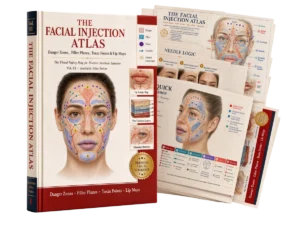
The Facial Injection Atlas: Danger zones · filler planes · toxin points · lip maps, Aesthetic Injection Atlas Series, Vol. 04 (PDF)
6 $
Format Publisher PDF
File size : 162.2 MB
Publisher : Publisher
Published year : 2026
VOL. 04 Premium Visual Atlas · New Release
THE FACIAL INJECTION ATLASDanger zones · filler planes · toxin points · lip maps.
A 65-page visual decision system for aesthetic injectors. Every page answers one question you must resolve before product is placed: where is the danger, which plane is safe, needle or cannula, how much, and what must be avoided.
Full-face danger maps · arterial network · five injection layers
One color code across the whole face — danger, filler, safe, cannula
Blindness pathways, aspiration discipline & reversal logic
Instant access · Read in clinic, study anywhere
Read the face in four moves
Not organized like a textbook — designed as a visual decision system
Identify the danger
Locate the artery, foramen, exclusion zone, or high-risk pathway before choosing a technique.
Map the plane
Decide superficial, deep, supraperiosteal, submuscular, or a defined safe glide plane.
Choose the instrument
Needle and cannula are not interchangeable — selection by vascular risk, plane, depth, vector.
Place with discipline
Smallest effective dose, slow delivery, low pressure, and immediate stop rules for warning signs.
Inside the atlas
Ad-clear at a glance. Clinic-precise on the page.
01
The Full-Face Danger Map
A single frontal plate maps every high-risk region — glabella, nasal dorsum, medial canthus, tear trough, infraorbital foramen, facial artery at the mandibular border, labial arteries, and the temporal branch. The danger is never only the vessel; it is the pathway: artery, anastomosis, pressure, plane, and volume.
02
Five Blindness Pathways
The eye can be reached from more than one zone. The atlas traces every route from a peripheral facial vessel back to the retinal circulation, pairs it with the three mechanisms of vascular occlusion, and lays out a Stop · Assess · Reverse · Escalate map — because aspiration reduces one risk, not all of them.
03
Region Maps with Hard Numbers
Each region carries the constants injectors reference on sight: the 1.5 cm cheekbone rule, the 0.50 ml tear-trough ceiling, McGregor’s point, the five-point Y-line for cheek structure, the mental foramen landmark, and the two-line cannula entry method. A safety rule is only useful when anchored to a palpable landmark.
04
Toxin Maps & Lip Reversal
A full-face toxin map covers frontalis biomechanics, the elevator–depressor balance of the glabella, brow-lift points with orbital-rim caution, and the lower face — masseter, DAO, mentalis, platysma. The lip section closes the atlas with labial-artery maps, vector technique, and migration-correction logic.
Be the first to review “The Facial Injection Atlas: Danger zones · filler planes · toxin points · lip maps, Aesthetic Injection Atlas Series, Vol. 04 (PDF)”
You must be logged in to post a review.
Related products


Reviews
There are no reviews yet.