


The Russina Lip Atlas: Vectors, Techniques & Reversal, Aesthetic Injection Atlas Series, Vol. 02 (PDF)
6 $
Format Publisher PDF
File size : 120.3 MB
Publisher : Publisher
Published year : 2026
The Russian lip, mapped.
Turned out — not simply fuller. Vectors, techniques & reversal.
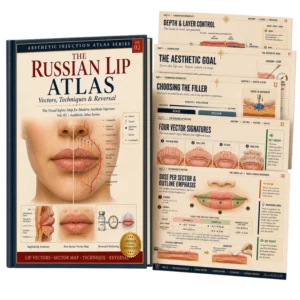
A 49-page vector-based chairside reference. Every page answers one question the lip asks: which vector, which sector, which depth, what dose — and how to reverse it when the tissue says no.
The full vector maps — 3 upper sectors, 2 lower sectors, dose per sector on the figure
Four vector signatures compared side by side — classic build, Doll Lips, 3D Kiss, Hard Lips
The Omnistrip fixation protocol, upper & lower lip
A complete reversal chapter — migration map, hyaluronidase prep, dissolve dosing
Why this atlas is different
Not a gallery of lips. A decision map.
Most references show an entry point or a final result. This atlas connects the decisions between them — in the order the lip asks them.
01
Assess
Read tissue capacity, density, existing filler and asymmetry — choose the signature before the syringe.
02
Vector
Vertical vectors, built sector by sector, medial to lateral — dose remembered per side.
03
Fixate
Omnistrip layouts on both lips — unfold, not cover; remove at 24–48 h.
04
Reverse
Migration map, allergy test, hyaluronidase prep — local removal or full dissolve.
The turn-out principle
Two ways to add volume. Only one turns the border out.
Horizontal placement adds width and forward volume. The Russian approach uses vertical vectors, built sector by sector, to evert the vermilion — a controlled turn, not inflation.
01 Divide
Visualise the sectors before the first vector.
02 Lay the vectors
Build medial to lateral, one sector after another.
03 Evert
Roll the border outward — and know when to stop.
Inside the atlas
Built to be opened before the lip is touched.
Real pages from the atlas — tap any spread to zoom.
01 · Upper lip
The upper-lip vector map
Three sectors per half, built medial to lateral, with the dose on the figure — roughly 0.2–0.3 ml per side, ~0.05 ml held at the central tubercle, and a 4–5 mm margin the commissure never gives back.
Three sectors · One repeatable architecture
02 · Lower lip
The lower-lip vector map
The lower lip gets its own map, not a scaled copy of the upper — two sectors per half, worked deeper with a 27G, centres first, the corners barely touched.
Fewer sectors · Different depth and sequence
03 · Depth control
Depth, bends & layer discipline
The two working bends — ~90° for deep placement, ~45° for contour, tip lateral — drawn against the tissue layers, with the consequence of wrong depth shown, not described.
The layer decides the result
04 · Fixation
Fixation that protects the shape
Upper- and lower-lip Omnistrip layouts mapped separately — unfold, not cover, removed at 24–48 h — including their role in holding eversion and limiting migration.
Create the turn · Hold the turn
05 · Fault states
Pitfalls & fault states
The five recurring faults — overfilled centre, migration roll, bridged commissure, surface lumps, asymmetry — each drawn as a recognisable state with its cause and its fix keyed back to an earlier page.
See the result · Trace the decision behind it
Be the first to review “The Russina Lip Atlas: Vectors, Techniques & Reversal, Aesthetic Injection Atlas Series, Vol. 02 (PDF)”
You must be logged in to post a review.
Related products








Reviews
There are no reviews yet.