

-
×
 Chronic Headache: A Comprehensive Guide to Evaluation and Management 1st ed. 2019 Edition, Kindle Edition
1 × 10 $
Chronic Headache: A Comprehensive Guide to Evaluation and Management 1st ed. 2019 Edition, Kindle Edition
1 × 10 $ -
×
 Adolescents with Chronic Kidney Disease
1 × 10 $
Adolescents with Chronic Kidney Disease
1 × 10 $ -
×
 Safety Concerns for Herbal Drugs
1 × 4 $
Safety Concerns for Herbal Drugs
1 × 4 $ -
×
 Absolute Obstetric Anesthesia Review: The Complete Study Guide for Certification and Recertification
1 × 10 $
Absolute Obstetric Anesthesia Review: The Complete Study Guide for Certification and Recertification
1 × 10 $ -
×
 History of Infectious Disease Pandemics in Urban Societies
1 × 4 $
History of Infectious Disease Pandemics in Urban Societies
1 × 4 $ -
×
 Arbeitgeber Patient – Kundenorientierung in Gesundheitsberufen
1 × 10 $
Arbeitgeber Patient – Kundenorientierung in Gesundheitsberufen
1 × 10 $ -
×
 Head and Neck Cancer: An Evidence-Based Team Approach
1 × 4 $
Head and Neck Cancer: An Evidence-Based Team Approach
1 × 4 $ -
×
 Dynamic Ophthalmic Ultrasonography: A Video Atlas for Ophthalmologists and Imaging Technicians (PDF)
1 × 4 $
Dynamic Ophthalmic Ultrasonography: A Video Atlas for Ophthalmologists and Imaging Technicians (PDF)
1 × 4 $ -
×
 Pharmacology of Ocular Therapeutics (PDF)
1 × 4 $
Pharmacology of Ocular Therapeutics (PDF)
1 × 4 $ -
×
 Lippincott's Concise Illustrated Anatomy: Volume 2: Thorax, Abdomen & Pelvis
1 × 4 $
Lippincott's Concise Illustrated Anatomy: Volume 2: Thorax, Abdomen & Pelvis
1 × 4 $ -
×
 West's Pulmonary Pathophysiology 9th
1 × 10 $
West's Pulmonary Pathophysiology 9th
1 × 10 $
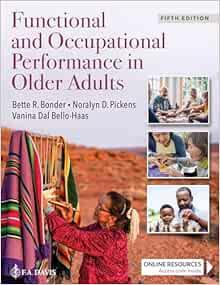
Functional Performance In Older Adults, 5th Edition (PDF)
7 $
Format : Publisher PDF
File Size : 60.9 MB
By Bette R. Bonder PhD OTR/L FAOTA, Noralyn D. Pickens PhD OT FAOTA, Vanina Dal Bello-Haas PhD Med BSc(PT)
Support the health, well-being, and quality of life of older adults! Here’s the ideal resource for students who are preparing to work with older adults. This text discusses the complexity of the aging experience, the science that contributes to positive aging, and the specific considerations that occupational therapy practitioners must bring to their efforts to support older adults. You’ll find descriptions of the normal aging process, discussions of how health and social factors can impact your clients’ ability to participate in valued occupations, and guidance on how to develop occupation-based strategies for maximizing their well-being.
New Chapters! Features nine new chapters, Aging and Culture; Identity, Sexuality, and Relationships; Legal and Ethical Issues; Special Concerns in Care and Prevention; Metabolic Conditions; Home Management; Health Management and Sleep; Community Mobility and Driving; Caregiving; and Acute Care Services.
Revised! Features a reconceptualized section, Aging: Body Structures and Body Functions, with chapters addressing both normal aging and health conditions to provide a holistic perspective on functional and occupational performance in older adults and OT interventions.
Updated & Expanded! Addresses interprofessional practice as interprofessional collaboration to emphasize its importance in today’s healthcare environment and to clients.
New! Threads “Case Studies” throughout the chapters to encourage in-the-moment application of the content, and revisits those related to health conditions in the chapters on service delivery to help students appreciate the delivery of OT services in different care contexts.
Revised and Updated! Incorporates the most current evidence available and presents strategies supported by the evidence in “Promoting Best Practices” boxes.
New! Summarizes the assessments most relevant to older adult practice, occupation, and psychometrically best practices in an assessment table organized by ICF factors.
Encourages clinical reasoning with a “Mini-Case Study” and “Provocative Questions” at the beginning of each chapter and “Critical-Thinking Questions” at the end of each chapter with the author’s suggested responses in Appendix A.
Reviews assessment and intervention strategies.
Uses the International Classification of Function (ICF; World Health Organization) as its major organizing principle.
Read less
Product Details
Publisher : F.A. Davis Company; Fifth edition (February 15, 2024)
Language : English
Digital eBook : 592 pages
ISBN-10 : 1719647909
ISBN-13 : 978-1719647908
Be the first to review “Functional Performance In Older Adults, 5th Edition (PDF)”
You must be logged in to post a review.
Related products


Basic Medical Book
Diagnostic Electron Microscopy: A Practical Guide to Interpretation and Technique 1st Edition
10 $
Reviews
There are no reviews yet.