

-
×
 Supporting Sucking Skills In Breastfeeding Infants 2nd
1 × 4 $
Supporting Sucking Skills In Breastfeeding Infants 2nd
1 × 4 $ -
×
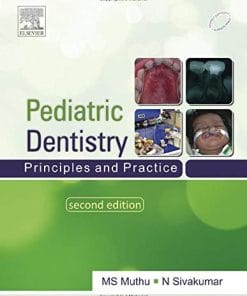 Paediatric Dentistry: Principles and Practice, 2nd Edition (PDF)
1 × 4 $
Paediatric Dentistry: Principles and Practice, 2nd Edition (PDF)
1 × 4 $ -
×
UCSF Radiology Review: Comprehensive Imaging 2014 (CME Videos)
1 × 10 $ -
×
 Esthetic Rehabilitation: Esthetic and Functional Integration of the Prosthetic Rehabilitation (CME VIDEOS)
1 × 60 $
Esthetic Rehabilitation: Esthetic and Functional Integration of the Prosthetic Rehabilitation (CME VIDEOS)
1 × 60 $
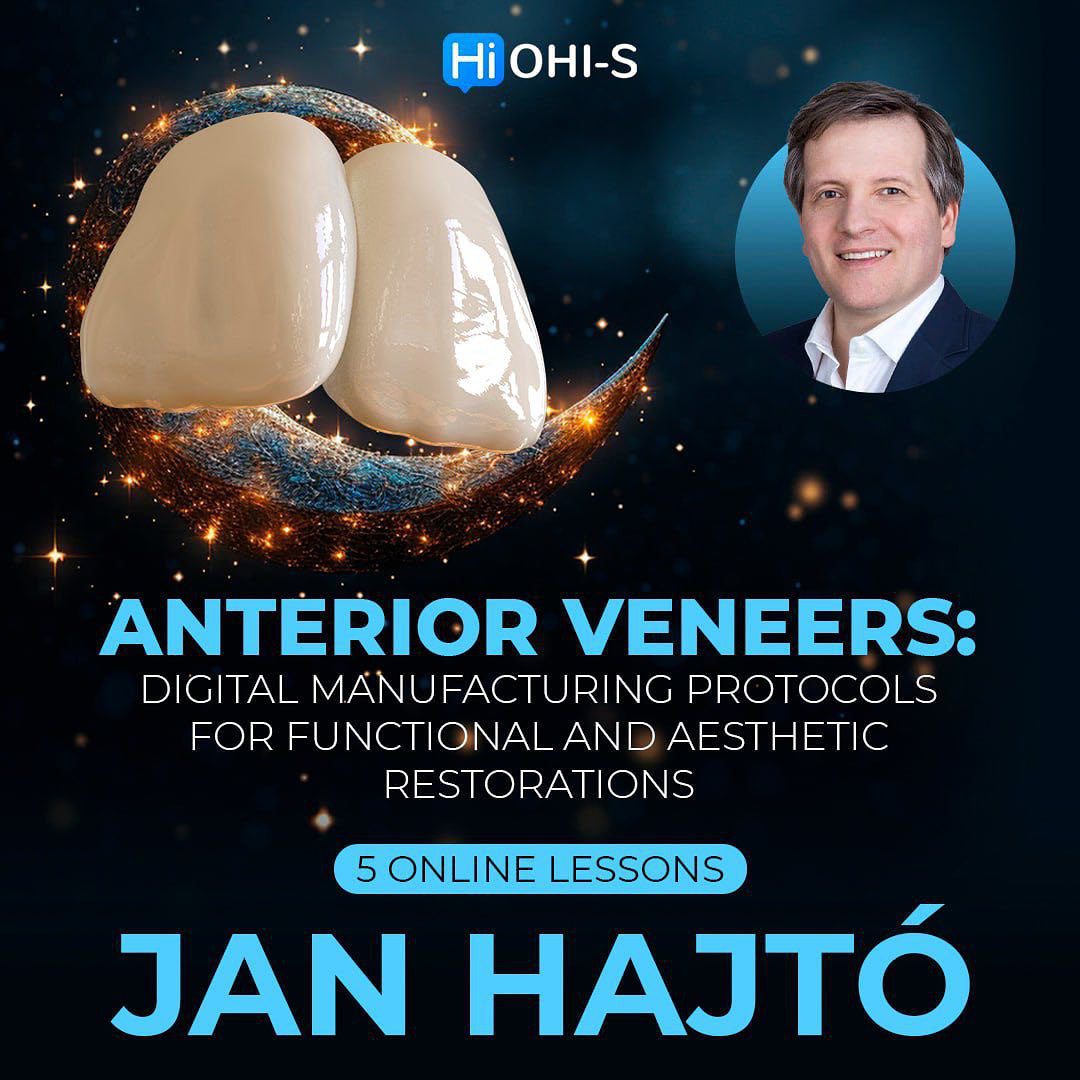
OHI-S Anterior veneers digital manufacturing protocols for functional and aesthetic restorations
35 $
Format : 6 videos + 6 audios + 6 file sub vtt, size: 2.12 GB
5 lessons + 1 free (3h 37min)
Jan Hajtó, the world’s leading expert in the application of digital technologies in aesthetic dentistry, will present you with a comprehensive guide on creating aesthetic and durable anterior laminate veneers using modern digital protocols.
During the course, you will learn:
– How to utilize digital technologies for diagnosis, treatment planning, and fabrication of veneers
– How to consider functional aspects when designing veneers
– How to create precise models of patients’ smiles using modern digital tools for scanning and tooth modeling.
The lecturer will share invaluable practical insights on veneer design and creation, including material selection, achieving coordinated shape and color, and navigating adhesion challenges. You will discover how to achieve a harmonious blend of aesthetics and functionality for optimal results.
The OHI‑S Anterior Veneers: Digital Manufacturing Protocols for Functional and Aesthetic Restorations course is best for dentists, prosthodontists, oral surgeons, and dental technicians who want structured, training in digital veneer workflows—from diagnosis and design to fabrication—ensuring both functional durability and aesthetic excellence.
Who Should Enroll
General dentists & prosthodontists seeking to integrate digital veneer protocols into daily practice.
Oral surgeons & implantologists who want to align surgical planning with prosthetic outcomes.
Dental technicians & lab professionals designing and fabricating veneers with CAD/CAM systems.
Residents, fellows, and trainees in restorative dentistry or prosthodontics needing structured digital training.
Clinicians transitioning from analog to digital workflows in aesthetic dentistry.
What You’ll Learn
Digital diagnosis & treatment planning: using CBCT, intraoral scanning, and smile design software.
Functional considerations: occlusion, TMJ pathology, and long‑term stability of veneers.
Manufacturing protocols: step‑by‑step guidance for non‑prep, minimally invasive, and invasive veneers.
Material selection: ceramics, composites, and digital fabrication options.
Analog vs. digital workflows: when to combine traditional methods with modern CAD/CAM.
Case‑based lessons: real patient examples for aesthetic and functional restorations.
+ Topics:
Lesson 1.Non-prep veneers and minimally invasive veneers. Introductory lesson
– Biomimetic approach in restoration
– Functional and aesthetic anterior laminate veneers: biomechanics
– Strength of adhesion to dentin
– Mechanical properties of ceramics
– Indications and contraindications for the use of veneers
– Properties of restorative materials
– Selection of materials for fabricating veneers on anterior teeth
– Tooth preparation for veneers
– Non-prep veneers
– Minimally invasive preparation for veneers
– Materials for veneer fixation
– The problem of applying the try-on gel.
Recommended for: Prosthodontists, Dental technicians, General dentists.
Lesson 2.Non-prep veneers and minimally invasive veneers
– Biomimetic approach in restoration
– Functional and aesthetic anterior laminate veneers: biomechanics
– Strength of adhesion to dentin
– Mechanical properties of ceramics
– Indications and contraindications for the use of veneers
– Properties of restorative materials
– Selection of materials for fabricating veneers on anterior teeth
– Tooth preparation for veneers
– Non-prep veneers
– Minimally invasive preparation for veneers
– Materials for veneer fixation
– The problem of applying the try-on gel.
Recommended for: Prosthodontists, Dental technicians, General dentists.
Lesson 3.Invasive veneers and veneer materials
– Partial additive veneers
– Steps for making an additive veneer
– Standard veneers: indications and preparation design
– Feldspar porcelain for anterior teeth veneers
– Lithium disilicate: properties and indications
– Cut-Back technique
– Invasive veneers and 360° veneers
– Treatment of amelogenesis imperfecta.
Recommended for: Prosthodontists, Dental technicians, General dentists.
Lesson 4.Diagnosis of pathologies of occlusion and TMJ in the manufacture of aesthetic restorations
– Important functional factors for the success of ceramic veneers
– Function and aesthetics: what are the main differences?
– TMJ and muscles screening
– TMD screening according to Ahlers/Jakstat
– Assessment of the condition of masticatory muscles
– Finding occlusal interference
– Occlusion and TMD: relationship.
Recommended for: Prosthodontists, Dental technicians, General dentists.
Lesson 5.Occlusal aspects of creating veneers
– Occlusal concept:
– formation of the anterior guidance
– formation of a canine guidance.
– Sequential guiding surfaces concept
– Dynamic occlusion
– Basic occlusal parameters which are decisive for the longevity of anterior all-ceramic restorations
– Prevention of balancing and premature contacts
– “Stepstone” dentistry.
Recommended for: Prosthodontists, Dental technicians, General dentists.
Lesson 6.Analog and digital veneer manufacturing protocols
– Analog veneer manufacturing protocol:
– planning
– direct mock-up
– non-prep veneers
– wax-up
– use of a silicone key
– choice of material.
– Digital veneer manufacturing protocol:
– photo protocol
– visualization of the treatment plan
– digital methods for determining color
– digital impressions and intraoral scanners.
– Digital smile design and 3D visualization
– Digital modeling of tooth morphology
– Virtual mock-up
– Pressing technique
– QA session.
Recommended for: Prosthodontists, Dental technicians, General dentists.
Be the first to review “OHI-S Anterior veneers digital manufacturing protocols for functional and aesthetic restorations”
You must be logged in to post a review.
Related products
Dental Ebook And Video
Rasperini Masterclass: Interproximal Attachment Gain – The Challenge Of Periodontology
89 $
Dental Ebook And Video
FOR Esthetic Soft Tissue – Inaki Gamborena, Patrick Rutten and Luc Rutten
30 $
Dental Ebook And Video
ITI International Team for Implantology Webinar & Video Lectures Package Part-1 (99 Videos)
60 $
Dental Ebook And Video
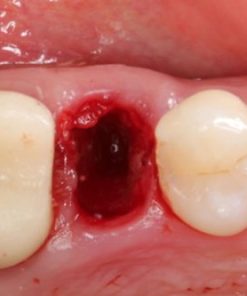
Extraction Socket – Preservation/Grafting; Immediate vs Delayed Implants; Pontic Site Development
38 $
Reviews
There are no reviews yet.