

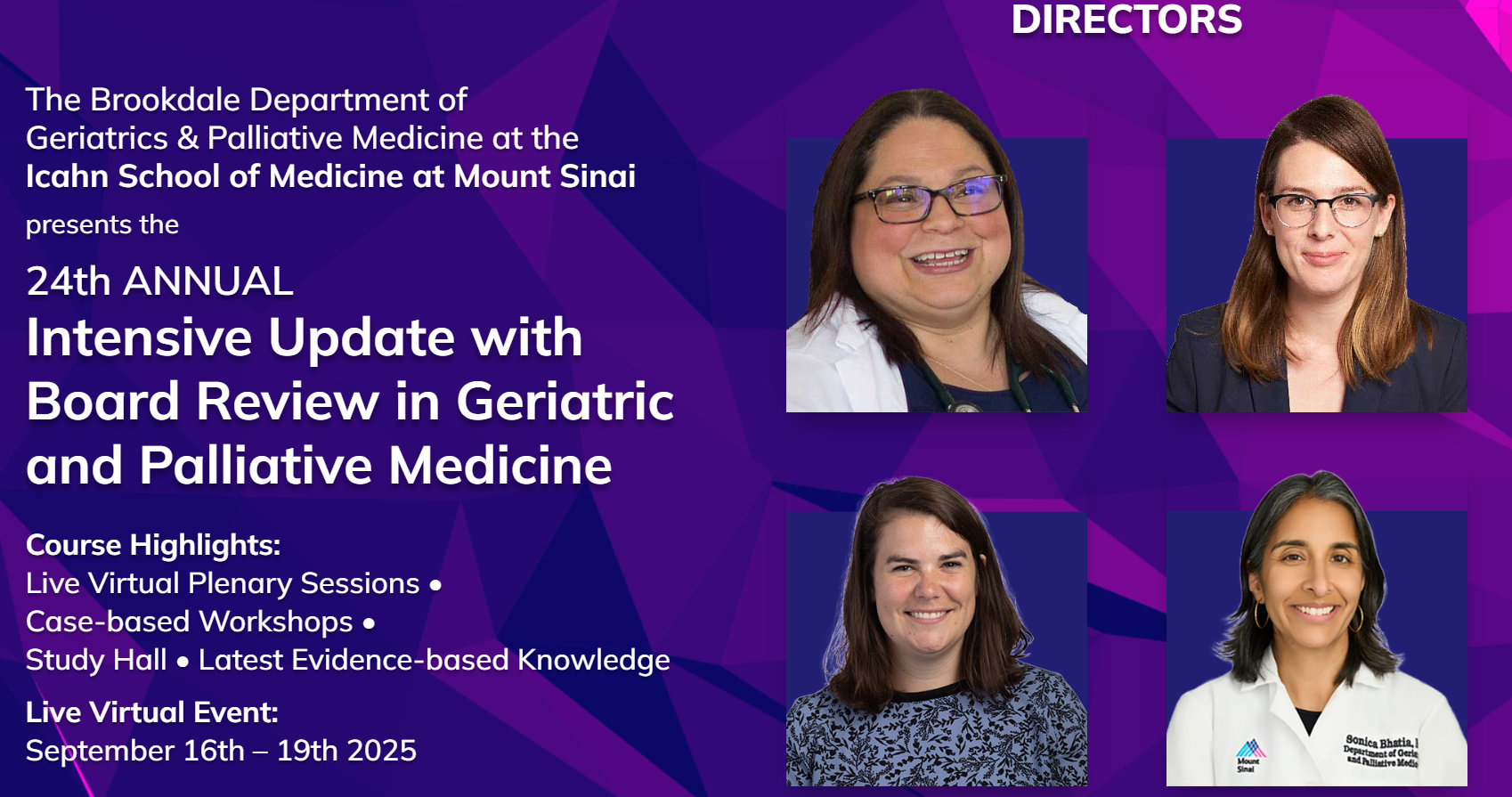
Mount Sinai 24th Annual Intensive Update with Board Review in Geriatric and Palliative Medicine 2025
100 $
Format :110 Videos (.mp4) + 110 Subtitles (.vtt) + 117 PDFs, size: 52.4 GB
1. Overview
The Mount Sinai 24th Annual Intensive Update with Board Review in Geriatric and Palliative Medicine 2025 offers a comprehensive, evidence-based review of key clinical topics for an aging population. The program focuses on the practical management of complex symptoms, multimorbidity, advance care planning, and the navigation of ethical considerations in serious illnesses across various care settings.
Course Date: Tuesday, September 16, 2025, 9:00 AM – Friday, September 19, 2025, 11:00 PM, Online
The Brookdale Department of Geriatrics and Palliative Medicine at the Icahn School of Medicine at Mount Sinai is the nation’s largest training program in the field and has trained one out of five geriatricians nationwide. We are offering the 24th annual “Intensive Update with Board Review in Geriatric and Palliative Medicine”. This is a four-day clinically-based intensive course in geriatrics and palliative medicine taught by leading experts in both fields providing updates on geriatric syndromes and palliative medicine and the latest research and treatments. Each day consists of eight live virtual plenary group sessions and 20 pre-recorded workshops designated to provide both practical experience with the large group material, as well as to cover other content areas. All workshops are case-based and can be viewed at the learner’s time discretion. Four Comprehensive Board Review Q&A sessions take place during Tuesday-Friday. This course is sponsored by the Mount Sinai School of Medicine, Brookdale Department of Geriatrics & Palliative Medicine.
2. Learning Objectives
Formulate comprehensive, interdisciplinary care plans for managing multimorbidity and safely de-prescribing medications in older adults.
Evaluate and manage complex symptoms such as total pain, behavioral issues in dementia, and palliative care emergencies.
Navigate advanced care planning, assess patient capacity, and facilitate effective serious illness communication with patients and families.
Apply evidence-based guidelines for the treatment of specific geriatric conditions, including heart failure, osteoporosis, and movement disorders.
Implement holistic and alternative interventions, including medical cannabis and expressive arts therapy, to improve patient quality of life.
3. Target Audience
Best for geriatricians and palliative care specialists who want updates on symptom management, multimorbidities, and advance care planning.
Specialties – Family Practice, General Practice, General Surgery, Genetics, Geriatric Medicine, Internal Medicine, Medical Education, Nursing
4. Topics
000 Welcome and Morning Announcements
001 Geriatrics, Palliative Care, and the Future of Healthcare
002 Movement Disorders Diagnosis and Treatment
003 De-Prescribing in the Context of Multi-Comorbidities
004 Beyond Alzheimer’s Dementia
005 Approach to Decision Making for Patients Who Lack Capacity
006 Hospice – There’s Always Something We Can Do
007 Prognostication of Chronic Disease
008 End-of-Life Symptom
009 Stepping Safely – A Guide to Geriatric Fall Evaluation for Healthy Aging
010 Models of Care at Home – Hospital and Palliative Care at Home
011 Basic Opioids 101
012 Geriatrics 5Ms – From Concept to Practice
013 Buprenorphine for Pain
014 Symptom Management II – Hiccups, Pruritus, Xerostomia, Fatigue, and Bowel Obstruction
015 Home Care
016 Annual Wellness Visit
017 Thyroid Disease in the Elderly Person
018 Low Back Pain
019 Identifying and Treating Osteoporosis
020 What is Geriatric Surgery Co-Management
021 Geriatrics and Palliative Care in the Nursing Home Setting
022 Nutrition-Hydration in Serious Illness
023 Assessing Capacity in Adult Patients
024 Care of Older Adults through Specialized Managed Care Models
025 Geriatric Nephrology & Renal Palliative Care
026 Perioperative Management
027 Integrative Therapies for Patient and Self Care
028 Stroke
029 Medical Decision Making
030 Update in Dementia
031 Principles of Geriatric Rehabilitation
032 Late Life Depression
033 Advance Care Planning – Trends and Clinical Practice
034 Symptom Management I – Constipation, SOB, Nausea and Anorexia
035 Prevention in Older Adults
036 Time Based and Billing Documentation
037 Surgical Emergencies
038 Chemotherapy Related Toxicity and Oncologic Complications
039 Palliative Care Emergencies
040 Clinician Well-being in Geriatrics and Palliative Medicine
041 Benign Prostatic Hyperplasia (BPH) & Prostate Cancer
042 Anemia
043 Grief, Bereavement and Psychosocial Issues
044 Advanced Pain Management – PCA & Methadone Use
045 Navigating Family Meetings
046 Musculoskeletal Medicine
047 Geriatric Care of Older Adults with HIV
048 Geriatric Emergencies
049 Office-Based Dementia Screening – Beyond the MMSE
050 Management of Heart Failure
051 Palliative Care in ALS
052 Sleep in the Elderly
053 Anxiety in Palliative Care Populations
054 Diagnosis and Evaluation of Peripheral Vascular Disease
055 The Era of Telemedicine for the Ambulatory Setting
056 Serious Illness Communication
057 Medicare and Medicaid Payment
058 Pediatric Palliative Care
059 Pain Management 101
060 Medication Management
061 Integrative Medicine in Geriatrics and Palliative Medicine
062 Maximizing Accessto Palliative Care Among Patients with Heart Failure
063 Caregiving
064 Hazards of Hospitalization
065 Oral Care for Older Adults – An Frequently Overlooked Issue
066 CAD Management – Cardiac and Perioperative Risk Assessment
067 Urinary Incontinence
068 Caring for Older Drivers
069 Wound Care
070 Physiology of Aging
071 Palliative Care in Hematological Malignancies – Bone Marrow Transplantation
072 Asthma and COPD
073 Atrial Fibrillation Management
074 Palliative Care for Pulmonary Disease
075 Overview of Gynecological Malignancies – Clinical Presentation and Treatment Options
076 Hearing Loss and Health in Older Adults
077 Discontinuing Life Sustaining Treatments (LST) – Withdrawal of Non-Beneficial Treatments While Maintaining Care
078 Geriatric Dermatology
079 The Life-Improving Benefits of Outpatient Palliative Care and Supportive Oncology
080 Frailty
081 Interventional Pain
082 Palliative Radiation Therapy
083 Hematologic Malignancies in the Elderly – Case Studies
084 Clinical Quality In The Nursing Home
085 Delirium – Are You Confused
086 Cardiovascular Disease – Part 1
087 Cardiovascular Disease – Part 2
088 AC Indications & Contraindications
089 Substance Use Disorder Care for Geriatrics and Palliative Medicine
090 All You Need is Love – Human Connection and Health
091 Don’t Kill Granny – Becoming a Better Doctor for Older Adults and the Seriously Ill
092 Hypertension in Older Adults
093 Use of Adjuvants for Pain Management
094 Overview of Medical Assistance in Dying
095 High Risk Ambulatory Geriatrics – The ALIGN Program
096 Crystal Arthropathies
097 Infectious Disease – Pneumonia, UTI’s and C-Dif
098 Management of Behavioral and Psychological Symptoms of Dementia
099 Managing Aortic Stenosis, Mitral Regurgitation & Antibiotic Prophylaxis
100 Addressing Total Pain – The Role of Interdisciplinary Teams
101 Geriatric Assessment Tools
102 Medical Cannabis – It’s High Time We Review the Evidence
103 Oncology – Breast, Lung & Colon Cancers
104 Digital Technology for Health Promotion and Disease Prevention in Older Adults
105 Hepatology for Geriatrics and Palliative Care Clinicians
106 Feeding and Swallowing Disorders
107 Anorexia, Cachexia and Weight Loss
108 Diabetes Overview
109 Management of Constipation and Fecal Incontinence in Older Adults
110 Expressive Arts Therapy and Child Life in the Support of Patients and Families
Be the first to review “Mount Sinai 24th Annual Intensive Update with Board Review in Geriatric and Palliative Medicine 2025”
You must be logged in to post a review.
Related products




Reviews
There are no reviews yet.