

-
×
 The Pharmacist Guide to Implementing Pharmaceutical Care
1 × 10 $
The Pharmacist Guide to Implementing Pharmaceutical Care
1 × 10 $ -
×
 Lippincott's Concise Illustrated Anatomy: Volume 2: Thorax, Abdomen & Pelvis
1 × 4 $
Lippincott's Concise Illustrated Anatomy: Volume 2: Thorax, Abdomen & Pelvis
1 × 4 $ -
×
 Bildgebung des Thorax bei Neugeborenen und Kleinkindern
1 × 10 $
Bildgebung des Thorax bei Neugeborenen und Kleinkindern
1 × 10 $ -
×
 Introduction to Radiologic and Imaging Sciences and Patient Care
1 × 5 $
Introduction to Radiologic and Imaging Sciences and Patient Care
1 × 5 $ -
×
 Field Guide to Wilderness Medicine 4th
1 × 4 $
Field Guide to Wilderness Medicine 4th
1 × 4 $ -
×
 Thyroid and Parathyroid Diseases: A Case-Based Guide 1st ed. 2019 Edition
1 × 10 $
Thyroid and Parathyroid Diseases: A Case-Based Guide 1st ed. 2019 Edition
1 × 10 $ -
×
 Adolescents with Chronic Kidney Disease
1 × 10 $
Adolescents with Chronic Kidney Disease
1 × 10 $ -
×
 Dilemma's bij dementie
1 × 10 $
Dilemma's bij dementie
1 × 10 $ -
×
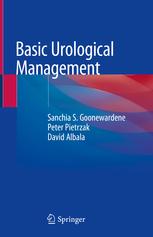 Basic Urological Management
1 × 10 $
Basic Urological Management
1 × 10 $
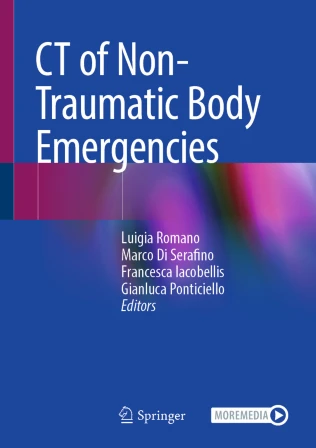
CT of Non-Traumatic Body Emergencies :
6 $
Format: Publisher PDF
The book aims to evaluate the diagnostic value of CT in patients with non traumatic body emergencies regarding neck, chest, abdomen, pelvis and extremities.
The multidisciplinary adopted CT protocols are clearly discussed because they play an essential role in diagnostic imaging for detecting different features essential for the differential diagnosis of diverse patologies.
The CT findings are correlated with clinical parameters that might correctly orientate the patients management. An ideal imaging method should ensure availability, high diagnostic accuracy, low invasiveness, low execution time, and low costs. Computed Tomography (CT) represents the “standard” imaging technique in the patient with non traumatic body emegencies due to the high diagnostic performance when a correct imaging protocol is adopted, despite radiation dose exposure and intravenous contrast agent administration. Technological advances in the field, lead to the development of post-processing techniques and dual-energy technology (DECT).
DECT offers slight advantages over traditional CT by scanning the same anatomical structures with different energy and allowing them to improve the contrast resolution, adopting lower radiation and contrast medium doses.
Hardcover ISBN
978-3-031-84848-3
Published: 03 June 2025
Be the first to review “CT of Non-Traumatic Body Emergencies :”
You must be logged in to post a review.
Related products
10 $

Reviews
There are no reviews yet.