

-
×
 Surgical Anatomy of the Ocular Adnexa: A Clinical Approach (Ophthalmology Monographs)
1 × 6 $
Surgical Anatomy of the Ocular Adnexa: A Clinical Approach (Ophthalmology Monographs)
1 × 6 $ -
×
 Integrative Therapies for Depression: Redefining Models for Assessment, Treatment and Prevention
1 × 5 $
Integrative Therapies for Depression: Redefining Models for Assessment, Treatment and Prevention
1 × 5 $ -
×
 101+ Careers in Public Health, 2nd Edition
1 × 5 $
101+ Careers in Public Health, 2nd Edition
1 × 5 $ -
×
 Renal Physiology: A Clinical Approach (Integrated Physiology Series)
1 × 4 $
Renal Physiology: A Clinical Approach (Integrated Physiology Series)
1 × 4 $ -
×
 Get Fit, Stay Fit, 7th Edition
1 × 5 $
Get Fit, Stay Fit, 7th Edition
1 × 5 $


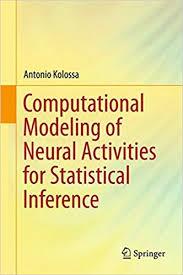
Computational Modeling of Neural Activities for Statistical Inference
18 $
by Antonio Kolossa (Author)
Computational Modeling of Neural Activities for Statistical Inference
by Antonio Kolossa (Author)
This authored monograph supplies empirical evidence for the Bayesian brain hypothesis by modeling event-related potentials (ERP) of the human electroencephalogram (EEG) during successive trials in cognitive tasks. The employed observer models are useful to compute probability distributions over observable events and hidden states, depending on which are present in the respective tasks. Bayesian model selection is then used to choose the model which best explains the ERP amplitude fluctuations. Thus, this book constitutes a decisive step towards a better understanding of the neural coding and computing of probabilities following Bayesian rules. The target audience primarily comprises research experts in the field of computational neurosciences, but the book may also be beneficial for graduate students who want to specialize in this field.
|
Related products



Basic Medical Book
Surgical Anatomy of the Ocular Adnexa: A Clinical Approach (Ophthalmology Monographs)
6 $