

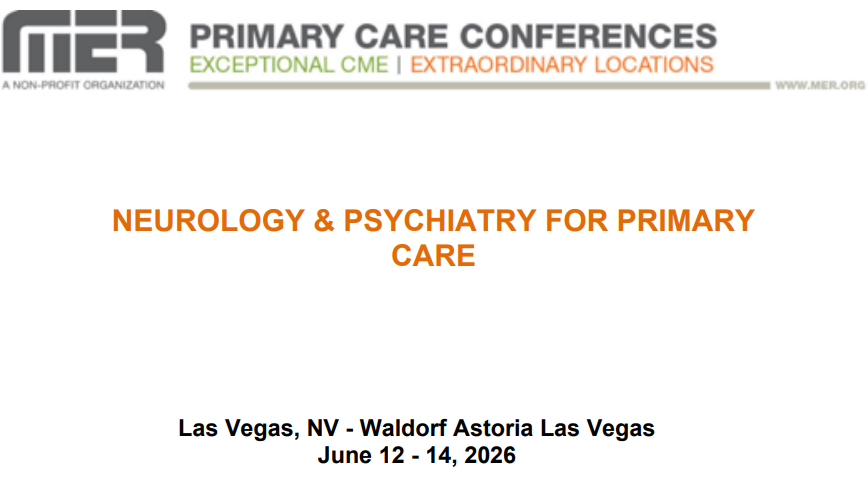
MER Primary Care Conferences Neurology & Psychiatry for Primary Care Jun 12-14, 2026
100 $
Format : videos + file sub vtt, size: GB
1. Overview
This is a primary care medical conference organized by Medical Education Resources (MER), a non-profit organization. The conference is titled “Neurology & Psychiatry for Primary Care”. It will take place from June 12-14, 2026, at the Waldorf Astoria Las Vegas in Las Vegas, NV.
2. Learning Objectives
Upon completion of this program, participants should be better able to:
Perform a neurological exam.
Discuss evidence-based management options for Alzheimer’s disease.
Describe the differential diagnosis and treatment options for migraine headaches.
Utilize prevention and treatment strategies for cerebrovascular disorders.
Explain the differential diagnosis of seizures.
Compare the side effect and clinical pharmacology profiles of anti-epileptic drugs.
Utilize history and physical examination to distinguish weakness from non-specific symptoms.
Discuss the mechanism of neuropathic pain.
Compare the benefits and side effect profiles of pharmacologic treatment options for ADHD.
Discuss mood stabilizing psychosocial and pharmacologic treatments of bipolar disorder as well as frequent co-morbid psychiatric disorders.
Describe strategies for identifying and treating substance use disorders.
Utilize case-based learning to develop treatment plans for psychiatric conditions.
3. Target Audience
This program is targeted to office-based primary care providers and other health professionals with updates in primary care medicine.
Best for internists, primary care physicians, neurologists, and psychiatrists.
4. Topics
Friday, June 12, 2026
Neurology – The Neurological Exam: Characteristics and objectives of the examination; exam phases; assessing general mental status; long-term predications; examination of infants; demonstration on conducting an exam.
Neurology – Alzheimer’s & Other Dementias: Definition; statistics; neurological changes of normal aging; pathology; etiological theories; vascular dementias; investigations; social issues; symptomatic treatment; research therapies.
Neurology – Headaches & Migraines: Basic headache mechanisms; headache history: characteristics, precipitating factors, medical conditions; migraine: common tension, classic, treatment, complicated, cluster, sinus; trigeminal neuralgia; Giant Cell Arteritis; brain tumor; subarachnoid hemorrhage; emergency room treatment.
Neurology – Diagnosis of Epilepsy, Paroxysmal Disorders, and Status Epilepticus: Types of paroxysmal disorders; diagnosis of seizures; seizures vs. epilepsy; classification of seizures and epileptic syndrome; initiation and discontinuation of drug therapy; therapeutic monitoring; intractable epilepsy.
Neurology – Treatment of Epilepsy and Status Epilepticus: Treatment of epilepsies; goals of treatment; initiation and discontinuation of drug therapy; therapeutic monitoring; intractable epilepsy.
Saturday, June 13, 2026
Neurology – Evaluating Weakness: Using the history and physical examination to distinguish weakness from non-specific symptoms; characteristics of neurological diseases that produce weakness; presentations of representative diseases of the nervous system.
Neurology – Neuropathy and Neuropathic Pain: Discussion of the spectrum of neuropathic signs, symptoms and causes; the approach to bedside examination; discussion of the mechanism of neuropathic pain; effective therapies.
Neurology – Cerebrovascular Disorders: Epidemiology; identifying the high-risk patient; treatment effects; transient neurological deficit: carotid, vertebrobasilar; non-specific cerebral symptoms; migraines vs. TIA; treatment options.
Psychiatry – The Complexity of Adult ADHD: ADHD in adults with an emphasis on symptom identification; Co-occurring conditions; Psychiatric and medical differential diagnosis; evidence-based and FDA approved pharmacological treatments.
Psychiatry – Bipolar Spectrum Disorders: Bipolar spectrum disorders in adults as compared to youth; Comprehensive history-taking; Differential diagnosis; Co-occurring psychiatric and medical conditions; Phase specific treatment considerations and interventions.
Sunday, June 14, 2026
Psychiatry – Substance Use Disorders: Social determinants of addiction; ASAM dimensions; Diagnosis of substance use disorder; Co-occurring disorders; Use of screening tools; Brief intervention; Stages of change; Treatment options; Motivational interviewing; Family systems and recovery.
Psychiatry – Catatonia Overview for Primary Care: Clinical signs and symptoms of catatonia; Pathophysiology and genetics; Associated morbidity and mortality risks; Diagnosis; Catatonia specific rating scales; Psychiatric and medical differential diagnosis; Medical work up and treatment options.
Be the first to review “MER Primary Care Conferences Neurology & Psychiatry for Primary Care Jun 12-14, 2026”
You must be logged in to post a review.
Related products




Reviews
There are no reviews yet.