

Harvard Critical Issues in Tumor Microenvironment Angiogenesis, Metastasis and Immunology 2025
100 $
Format : 20 videos + 20 sub file vtt + 14 pdfs, size: 21.26 GB
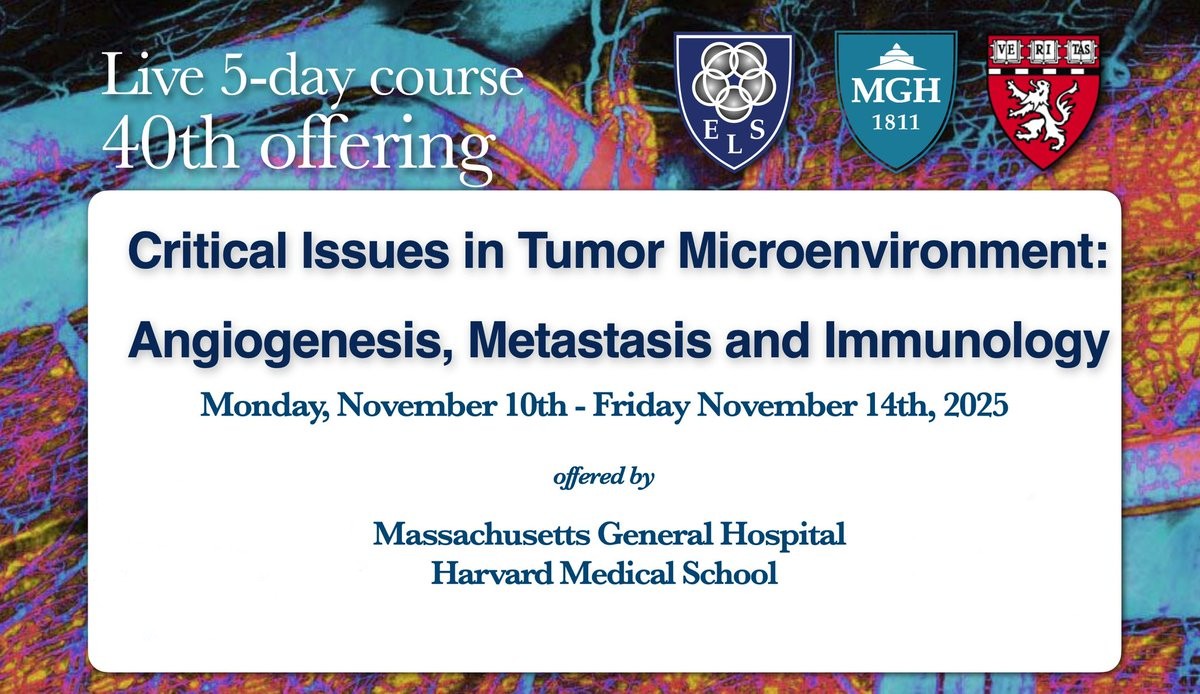
Critical Issues in Tumor Microenvironment: Angiogenesis, Metastasis and Immunology 40th Annual Offering November 10 – 14, 2025
The “40th Annual Critical Issues in Tumor Microenvironment: Angiogenesis, Metastasis and Immunology” course, directed by Professor Rakesh K. Jain, will continue to offer the best in critical analysis of what is currently known about the tumor microenvironment, including lectures covering: angiogenesis, metastasis, immunology, metabolism, microbiome, chronobiology, carcinoma-associated fibroblasts, cancer-neuroscience, adoptive cell therapies including chimeric antigen receptor (CAR) T-cells, and integrating physical sciences and AI in oncology. The faculty is internationally recognized. They will present the latest findings from their laboratories and clinics. The goal of this course is to highlight key gaps in present knowledge of cancer and outline future directions for research at the bench and in the clinic.
The course will return to a four-day in-person format. Learning formats will include didactic lectures, trainee-led Q&A and group discussions. The faculty will encourage an open discussion and will provide critical comments on challenges and future opportunities in research in cancer and in the establishment of novel therapeutic approaches and biomarkers to guide treatment. The aim of this course is to analyze and synthesize the most up-to-date findings. Our faculty will present valuable information in a systematic and comprehensive framework, along with a critical review of various measurement techniques. This course is dedicated to helping to improve clinical translation of this knowledge and competence, leading to improved cancer treatment.
To celebrate the 40th anniversary, we have added a 5th Trainee-focused day to our course where the course participants will have the opportunity to present a scientific poster during a poster symposium, along with attend a roundtable discussion session on career guidance for biomedical scientists and engineers.
LEARNING OBJECTIVES:
Upon completion of our Critical Issues in Tumor Microenvironment course, participants will be able to:
Identify pharmacological approaches to normalize the tumor microenvironment, including tumor-associated blood vessels, fibroblasts and the extracellular matrix
Evaluate molecularly targeted agents approved or currently in clinical development in combination with immunotherapies for cancer treatment and incorporate them into practice.
Assess relevant, state-of-the-art, or translational pre-clinical models of anti-cancer therapies for adult and pediatric malignancies.
Recognize the steps and determinants of the metastatic process of cancer.
Identify emerging determinants of immunotherapy outcomes, including blood vessels, fibroblasts, extracellular matrix, neuronal-tumor interactions, circadian cycle, microbiome, and discuss potential approaches to harness them.
Compare correlative studies of biomarkers and their response and resistance to immunotherapies in cancer patients.
Evaluate state-of-the-art genetic and imaging techniques and their applications in pre-clinical and clinical studies.
Understand the applications of AI in cancer care and research
Who Should Attend This Course?
The course is directed at physicians and researchers.
The Harvard Critical Issues in Tumor Microenvironment: Angiogenesis, Metastasis and Immunology 2025 course is best for oncologists, cancer researchers, immunologists, translational scientists, and advanced trainees who want cutting‑edge, multidisciplinary insights into tumor biology, angiogenesis, metastasis, immunology, and emerging therapies.
Who Should Attend
Medical oncologists and hematologists seeking deeper understanding of tumor biology to guide clinical practice.
Cancer researchers and translational scientists working on angiogenesis, metastasis, immunotherapy, and tumor microenvironment.
Immunologists and molecular biologists studying immune regulation and cancer immunotherapy.
Radiation and surgical oncologists interested in how microenvironmental factors influence treatment outcomes.
Pharmaceutical and biotech professionals developing anti‑cancer drugs, biologics, and cell therapies.
Graduate students, postdocs, and fellows in oncology, immunology, or biomedical sciences preparing for academic or industry careers.
What You’ll Learn
Tumor microenvironment fundamentals: angiogenesis, metastasis, immunology, metabolism, microbiome, and chronobiology.
Emerging therapeutic strategies: adoptive cell therapies (CAR‑T, TCR), checkpoint inhibitors, and novel biologics.
Cancer neuroscience and fibroblast biology: how stromal and neural interactions drive tumor progression.
Integration of physical sciences and AI in oncology: innovative approaches to modeling and predicting tumor behavior.
Clinical translation: bridging laboratory discoveries with patient care to improve cancer treatment outcomes.
+ Topics:
Monday, November 10, 2025
9:00 A.M
Check-in/Registration, Continental Breakfast
10:00 A.M.
Opening Remarks Rakesh K. Jain
10:10 A.M.
Tumor Microenvironment I: Angiogenesis and Vascular Function Rakesh K. Jain
11:20 A.M.
Q&A
11:35 A.M.
Break
11:50 A.M.
Tumor Microenvironment II: Vascular Normalization and Immunotherapy Rakesh K. Jain
1:10 P.M.
Q&A
1:25 P.M.
Lunch Break – Boxed lunches provided
2:25 P.M.
Tumor Microenvironment III: Extracellular Matrix, Lymphatics and Metastasis Rakesh K. Jain
3:45 P.M.
Q&A
4:00 P.M.
Break
4:30 P.M.
Cancer Immunology and Immunotherapy Overview Arlene Sharpe
5:35 P.M.
Q&A
5:50 P.M.
Adjourn
Tuesday, November 11, 2025
9:00 A.M.
Continental Breakfast
10:00 A.M.
Circadian Clock and Metabolic Vulnerabilities of Cancer Chi Van Dang
11:05 A.M.
Q&A
11:20 A.M.
Break
11:50 A.M.
Skull Bone Marrow as a Site for Immuno-Surveillance of Healthy Brain and Brain Tumors Jonathan Kipnis
12:55 P.M.
Q&A
1:10 P.M.
Lunch Break – on your own
2:10 P.M.
Determinants of How Tumors Use Metabolism to Support Growth Matthew Vander Heiden
3:15 P.M.
Q&A
3:30 P.M.
Break
4:00 P.M.
Using Cell Transfer to Remodel the Tumor Microenvrionment Carl June
5:05 P.M.
Q&A
5:20 P.M.
Adjourn
Wednesday, November 12, 2025
9:00 A.M.
Continental Breakfast
10:00 A.M.
AI in Basic and Clinical Oncology Eliezer Van Allen
11:05 A.M.
Q&A
11:20 A.M.
Break
11:50 A.M.
Microbiota: a Key Orchestrator of Cancer Therapy Giorgio Trinchieri
12:55 P.M.
Q&A
1:10 P.M.
Lunch Break – on your own
2:10 P.M.
Identifying Immune Vulnerabilities in Solid Tumors Lisa Coussens
3:15 P.M.
Q&A
3:30 P.M.
Break
4:00 P.M.
RREBELLIOUS INTERFERENCE: Challenging old paradigms and discovering new strategies for targeting pediatric brain tumors Robert Wechsler-Reya
5:05 P.M.
Q&A
5:20 P.M.
Adjourn
Thursday, November 13, 2025
9:00 A.M.
Continental Breakfast
10:00 A.M.
Dissecting the Ecosystem of Gliomas by Single-Cell and Spatial Genomics Mario Suva
11:05 A.M.
Q&A
11:20 A.M.
Break
11:50 A.M.
Mechanisms of Malignant Progression Robert Weinberg
12:55 P.M.
Q&A
1:10 P.M.
Lunch Break – on your own
2:10 P.M.
Fibroblast Heterogeneity in Solid Tumors: Implications for Pancreatic Cancer David Tuveson
3:15 P.M.
Q&A
3:30 P.M.
Break
4:00 P.M.
Neural Influences on Primary and Metastatic Brain Tumors Frank Winkler
5:05 P.M.
Q&A
5:20 P.M.
Summary and closing remarks Rakesh K. Jain
Friday , November 14th, 2025
9:00 A.M.
Poster set up/ Continental Breakfast
10:00 A.M.
Lessons from the Clinic: Novel Diagnostics and Therapeutic Outcomes George Sledge
11:20 A.M.
Break
11:50 A.M.
Emerging strategies to improve CAR-T cell therapy for glioblastoma and other solid tumors Hideho Okada
1:10 P.M.
Lunch Break – Boxed lunches will be provided
2:10 P.M.
Poster Session
3:10 P.M.
Poster Award Presentation
3:30 P.M.
Career Round Table Discussion
Academia: Frank Winkler, MD, PhD |Eva Sevick-Muraca, PhD | Melody Swartz, PhD
Industry: George Sledge, MD | Zohreh Amoozgar, PhD
Law Firm: Carla Mouta-Bellum, PhD, JD
5:00 P.M.
Networking Reception
Be the first to review “Harvard Critical Issues in Tumor Microenvironment Angiogenesis, Metastasis and Immunology 2025”
You must be logged in to post a review.
Related products




Reviews
There are no reviews yet.