


OHI-S Predictable Functional Occlusion Roth Philosophy, Masahiro Kuwata’s Protocols, and the TMJ-First Concept
55 $
Format : 10 videos + 10 audios + 10 file sub vtts, size: 7.5 GB
The OHI‑S Predictable Functional Occlusion: Roth Philosophy, Masahiro Kuwata’s Protocols, and the TMJ‑First Concept course is best for prosthodontists, orthodontists, restorative dentists, and advanced general practitioners who want to master occlusion principles that integrate temporomandibular joint (TMJ) health, functional stability, and aesthetic excellence in restorative and orthodontic treatment planning.
Who Should Attend
Prosthodontists and restorative dentists managing complex full‑mouth rehabilitation cases.
Orthodontists applying Roth philosophy in occlusion and TMJ‑guided treatment planning.
General dentists seeking advanced occlusion knowledge to improve restorative predictability.
Periodontists and oral surgeons integrating occlusal concepts into multidisciplinary care.
Residents and postgraduate trainees in prosthodontics, orthodontics, or restorative dentistry.
Dental technicians interested in occlusion protocols that influence prosthetic design.
What You’ll Learn
Roth philosophy of occlusion: functional occlusion principles rooted in TMJ health and stability.
Masahiro Kuwata’s protocols: laboratory and clinical techniques for predictable occlusal outcomes.
TMJ‑First concept: prioritizing temporomandibular joint position and function before restorative or orthodontic intervention.
Treatment planning strategies: integrating occlusion, TMJ, and aesthetics for long‑term success.
Clinical applications: case‑based examples in orthodontics, prosthodontics, and restorative dentistry.
Course Details
Organizer: OHI‑S (Online Dental Education Platform)
Format: Online modules with lectures, case studies, and practical demonstrations
Faculty: International experts in occlusion, orthodontics, and prosthodontics
Access: 10 lessons (7h 59min)
+ Topics:
Lesson 1.TMJ and Occlusion. Roth Philosophy in Orthodontic Treatment
– Defining the goals of orthodontic treatment according to Roth philosophy
– Treatment planning from the seated condylar position
– Defining the normal position of the temporomandibular joint’s articular disc
– Function of the temporomandibular joint’s articular disc
– Protocols for centric relation bite registration
– Stages of disc displacement
– Analysis of clinical cases.
Recommended for: Orthodontists, Prosthodontists, Functional dentists, Restorative dentist, General dentists.
Lesson 2.Functional TMJ and harmonious orthodontic treatment
– Protocols to harmonize the bite and the temporomandibular joint (TMJ)
– How to diagnose the condition of the TMJ: history, chairside examination, mounted models, imaging (MRI and CBCT)
– Stability of jaw position in clinical practice
– Analysis of jaw position before and after orthodontic treatment using MRI, CBCT, and mandibular movement records
– Treatment protocols for patients with disc displacement (DD)
– The effect of jaw position stabilization on mandibular growth
– Application of the stabilization splint before and during orthodontic treatment.
Recommended for: Orthodontists, Prosthodontists, Functional dentists, Restorative dentist, General dentists.
Lesson 3.Occlusion Based on the Functionally Discluded Concept by Masahiro Kuwata
– Analysis of the first full-mouth reconstruction case using the functionally discluded occlusion concept by Masahiro Kuwata
– Basic principles of functionally discluded occlusion
– Defining centric relation, centric relation occlusion, and intercuspal position
– Occlusion and the relationship between the upper and lower dentition in a static position
– Relationship between the upper and lower dentition in dynamic positions and the occlusal pathway.
Recommended for: Orthodontists, Prosthodontists, Functional dentists, Restorative dentist, General dentists.
Lesson 4.Occlusal Adjustment Techniques Based on Functionally Discluded Occlusion
– Protocols for achieving stability of occlusion
– Physiological occlusion in clinical practice
– Examination and diagnosis of occlusal disharmony
– Step-by-step procedures for occlusal adjustment in cases of disharmony
– The concept of the “Area of Centric”
– Trim-off adjustment and add-on adjustment in full-mouth cases
– The importance of immediate disclusion in restorative teeth
– Analysis of clinical cases.
Recommended for: Orthodontists, Prosthodontists, Functional dentists, Restorative dentist, General dentists.
Lesson 5.Internal Derangements of the TMJ: Diagnosis and Occlusal Considerations
– History and evaluation of the new gnathology concept
– The relationship between occlusal development and maxillofacial development
– Defining the therapeutic mandibular position
– Arthrography of disc and condyle derangement
– Effects and sequelae of internal derangement of the TMJ
– Diagnosis of internal derangement and condylar displacement
– Frequency of internal derangement in orthodontic patients
– Defining centric relation in cases of TMJ derangement.
Recommended for: Orthodontists, Prosthodontists, Functional dentists, Restorative dentist, General dentists.
Lesson 6.Reference Therapeutic Position (RP-ThP) Concept
– Reference position (RP-ThP Concept)
– Diagnosis of mandibular deviation and temporomandibular disorders
– Diagnosis of internal derangement of TMJ
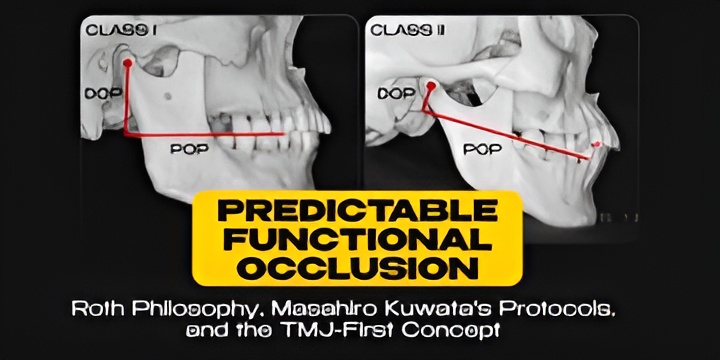
– Occlusal plane and mandibular position:- Occlusal plane alteration and mandibular adaptation
– Posterior occlusal plane and occlusal support
– Distance between occlusal plane and condyle support
– Flat and steep posterior occlusal plane and the risk of TMD.
Recommended for: Orthodontists, Prosthodontists, Functional dentists, Restorative dentist, General dentists.
Lesson 7.Role and Effectiveness of Orthodontics in the Treatment of Malocclusion and TMJ Dysfunction
– Protection of the TMJ by occlusion
– Efficacy of orthodontic occlusal construction in the treatment of TMJ disorders
– Step-by-step treatment protocols for TMD using orthodontic and functional therapy
– Analysis of clinical cases.
Recommended for: Orthodontists, Prosthodontists, Functional dentists, Restorative dentist, General dentists.
Lesson 8.Functional Occlusion: Comprehensive Diagnostic Protocols
– Designing sequential, functionally guided occlusion in clinical practice
– Diagnosis of skeletal patterns
– Examination of jaw function
– Diagnostic protocols considering functional occlusion
– Protocols for model analysis using the articulator
– Analysis of cephalometric radiographs
– Step-by-step diagnosis of occlusion using analog and digital workflows
– Analysis of clinical cases.
Recommended for: Orthodontists, Prosthodontists, Functional dentists, Restorative dentist, General dentists.
Lesson 9.Occlusal Reconstruction with Consideration of Jaw Function
– Protocols for controlling mandibular position and the occlusal plane
– Protocols for determining occlusal vertical dimension
– Purpose of pre-prosthetic orthodontics
– Strategic leveling
– Orthodontics using MEAW
– Prosthetic treatment planning
– Follow-up after occlusal reconstruction treatment.
Recommended for: Orthodontists, Prosthodontists, Functional dentists, Restorative dentist, General dentists.
Lesson 10.Digital Protocol for Sequential Occlusion: Working with the Concept of Rudolf Slavicek
– Introduction to protocols of sequential occlusion within the Slavicek philosophy
– Protocols for using the virtual articulator: techniques for simulating dynamic occlusion
– Digital facebow mounting protocols: methods for transferring spatial jaw relations
– Protocols for digital simulation of proper mandibular position: using condylography and jaw tracking
– Workflow and protocols for creating digital dentures in sequential occlusion
– Protocols for designing occlusal surfaces digitally: techniques for cusp-fossa coordination
– Integration of protocols into clinical cases: examples and digital techniques applied
– Q&A session.
Recommended for: Orthodontists, Prosthodontists, Functional dentists, Restorative dentist, General dentists.
Be the first to review “OHI-S Predictable Functional Occlusion Roth Philosophy, Masahiro Kuwata’s Protocols, and the TMJ-First Concept”
You must be logged in to post a review.
Related products


Reviews
There are no reviews yet.