


Harvard Global Mental Health Trauma and Recovery 2025
130 $
Format : 16 videos + pdf, size: GB
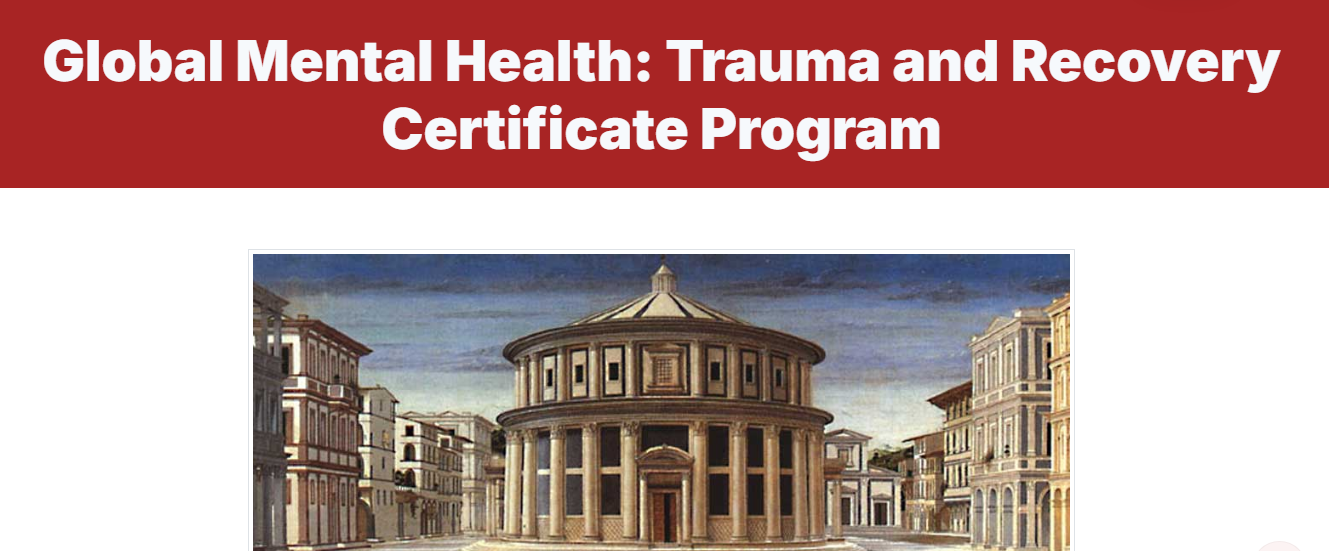
GLOBAL MENTAL HEALTH: Trauma and Recovery Certificate Program 2025
September 23rd – 25th , 2025
The Harvard Program in Refugee Trauma (HPRT) and the Harvard Medical School are offering an extraordinary 3‑day online certificate program, Global Mental Health: Trauma and Recovery (GMH). The program provides training for health care practitioners, humanitarian relief workers and policy planners addressing the health and mental health sequelae of traumatized patients and communities. The curriculum is adaptable for diverse populations and global environments affected by violence, natural disasters, and climate change.
The Global Mental Health: Trauma and Recovery Certificate Program is the first of its kind in global mental health, trauma, and post-conflict/disaster recovery. The major rationale for this Certificate Program emerged from 40+ years of clinical care, training, and research by the faculty with survivors of violence and natural disasters throughout the world.
In collaboration with Caritas Rome, Fulbright New Century Scholars Program and the World Bank, HPRT and the Italian Istituto Superiore di Sanità (ISS) developed the global Project 1 Billion: International Congress of Ministers of Health for Mental Health and Post-Conflict Recovery. In December 2004, this project brought together Ministers of Health from the world’s post-conflict countries to endorse a science-based, culturally effective and sustainable Mental Health Action Plan and Book of Best Practices for post-conflict recovery. Project 1 Billion revealed the great need for the education and capacity building of health care professionals, international relief workers and policy makers in the area of mental health. This Global Mental Health: Trauma and Recovery Certificate Program is a major result of Project 1 Billion.
Upon successful completion of the GMH program, participants receive a certificate of completion from the Harvard Program in Refugee Trauma and a certificate of participation with continuing medical education credits from Harvard Medical School.
Mission and Learning Objectives
More than one billion people have been affected by violence and disasters throughout the world. Our mission is to maximize a scientific and cultural approach and methodology to reduce suffering, minimize disabilities, and increase resiliency for survivors of violence worldwide. This Program offers a transformative training experience to create a network of global leaders in mental health recovery.
Upon completion of the certificate program, participants will be able to:
Integrate science, culture, and evidence-based knowledge and practices in policy planning, clinical care, humanitarian, and human rights activities.
Implement and use advances in the neurosciences and cultural knowledge of the clinical care of traumatized persons, their families, and communities.
Define effective scientific approaches for the care of survivors of extreme violence and climate change.
Analyze the important historical scientific and evaluation approaches to the care of survivors of trauma.
Apply professional development and ethics in working with vulnerable populations.
Understand the impact of trauma on the bio-psycho-social and spiritual state of survivors of trauma.
Learn methods for self-care.
Learning Approach
The program participants will receive an e-copy of the textbook Global Mental Health: Trauma and Recovery: A Companion Guide for Field and Clinical Care of Traumatized People Worldwide. Lectures to be presented by globally recognized leaders in their respective fields and will follow the eight dimensions of the Global Mental Health Action Plan. Participants will also receive the HPRT 11 Point Clinical Toolkit for Healing Wounds of Mass Violence and Disasters.
Topics
The program’s emphasis is on learning an integrated holistic approach to policy planning and clinical care using the HPRT Global Mental Health Action Plan.
Topics include:
Phenomenological theory of trauma and recovery developed by HPRT and international colleagues over 40 years.
Epidemiology and the neuroscience of trauma.
The HPRT Global Mental Health Action Plan.
Trauma-informed Care.
Mental Health Diagnosis and Treatment of Mental Health and Medical Disorders.
Scientific (Evidence-Based) and Culturally Valid Best Clinical Practices.
The new H5 Model for field based psychosocial and clinical approach to recovery.
Health and mental health impact of health disparities.
Human Rights and Rebuilding Social Capital.
Working in Interdisciplinary Medical Teams.
Scientific and culture-based approach to leadership.
Climate change and ecocide.
The importance of Self-care.
Be the first to review “Harvard Global Mental Health Trauma and Recovery 2025”
You must be logged in to post a review.
Related products






Reviews
There are no reviews yet.