


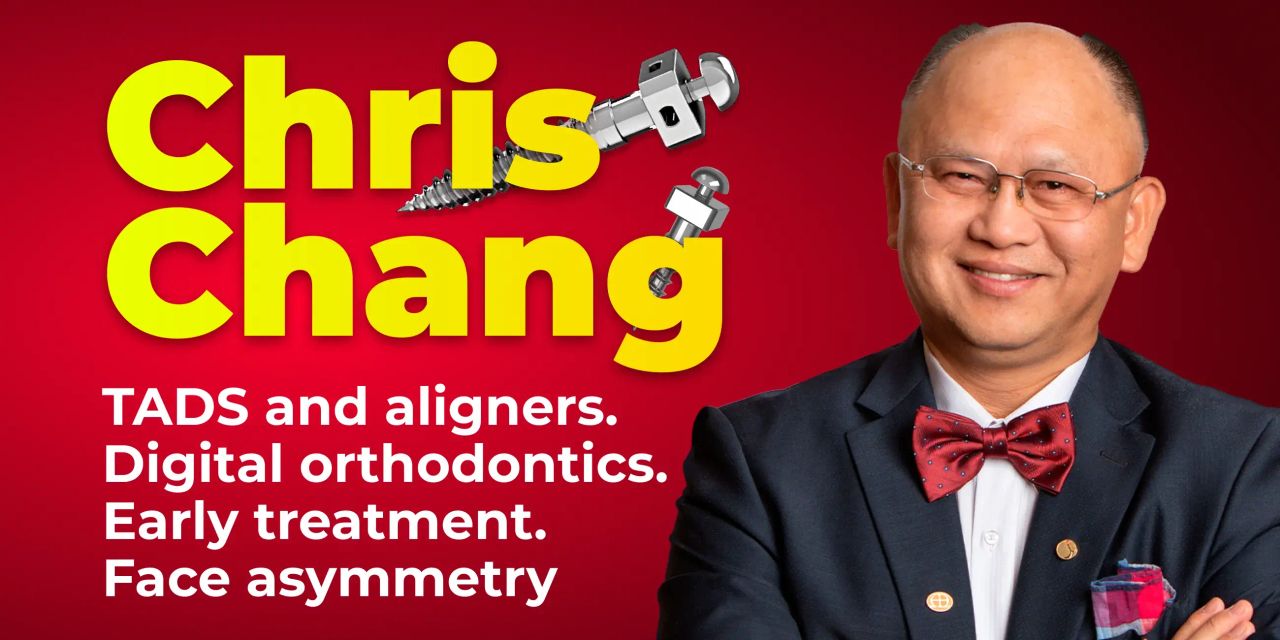
OHI-S TADs and aligners. Digital orthodontics. Early treatment. Face asymmetry
120 $
Format :14 videos + 14 audios + 14 file sub vtt, size: 11.2 GB
14 lessons (19h 15min)
Chris Chang is a real living legend of orthodontics in the 21st century! He is one of the most prominent and influential orthodontists on the planet. He is famous for his incredibly effective practical solutions.
During the online course, Chris Chang will talk about:
– early orthodontic treatment
– author’s methods of impaction treatment
– combined use of TADs and aligners
– minor surgeries in daily orthodontic practice
– asymmetry treatment protocol
– non-surgical correction of anterior open bite
– сonservative treatment of Class 2 and Class 3
– digital orthodontics
– ortho-implant connections.
The OHI‑S TADs and Aligners. Digital Orthodontics. Early Treatment. Face Asymmetry program is best for orthodontists, pediatric dentists, and general dentists with orthodontic practice who want structured, training in advanced orthodontic protocols using temporary anchorage devices (TADs), clear aligners, and digital workflows. It emphasizes evidence‑based early treatment strategies and management of facial asymmetry through interdisciplinary approaches.
Who Should Enroll
Orthodontists treating complex cases requiring skeletal anchorage (TADs), aligner biomechanics, and digital planning.
Pediatric dentists managing early orthodontic interventions in growing patients.
General dentists with orthodontic focus who want to integrate digital orthodontics and aligners into practice.
Oral & maxillofacial surgeons collaborating on facial asymmetry cases requiring orthodontic preparation.
Residents & fellows in orthodontics or pediatric dentistry seeking advanced training in digital orthodontics and early treatment.
Dental technicians supporting digital workflows, aligner fabrication, and appliance design.
What You’ll Learn
TADs protocols: clinical use of temporary anchorage devices for complex tooth movement.
Aligner biomechanics: evidence‑based strategies for predictable outcomes with clear aligners.
Digital orthodontics: CAD/CAM workflows, 3D planning, and integration with aligner systems.
Early treatment: interceptive orthodontics leveraging growth potential to prevent severe malocclusions.
Facial asymmetry management: interdisciplinary protocols combining orthodontics, surgery, and restorative care.
Case‑based lessons: real examples of digital orthodontics, TADs, and asymmetry correction.
+ Topics:
Lesson 1.Early orthodontic treatment
– Systematic diagnostic approach
– Principles of early orthodontic treatment
– Problems of early orthodontic treatment
– When early orthodontic treatment is required
– Conditions for early orthodontic treatment
– Early orthodontic treatment planning
– Elimination of bad habits leading to the occurrence of malocclusion
– Using the technique 2*4. Detailed protocol
– Detailed protocol for early treatment of impacted teeth
– Use of palatal expansion in early orthodontic treatment
– Centric relationship control.
Recommended for: Orthodontist, General Dentist.
Lesson 2.Class 2 correction: ELSE, Bite Turbo, IZC
– Simplified and effective technique for the treatment of class 2
– Use of ELSE and Bite Turbo braces
– Protocol for the treatment of overjet (10 mm) using microimplants
– Protocol for the treatment of class 2 in adult patients
– Biomechanics of class 2 treatment
– Sequence of arches in the class 2 treatment
– Use of IZC implants
– Detailed protocol for the treatment of tooth transposition.
Recommended for: Orthodontist, General Dentist.
Lesson 3.Ortho-implant connections
– Planning of orthodontic preparation before prosthetics and implantation
– Orthodontic space closure after extraction of individual teeth: detailed protocol
– Choice of ortho-implant treatment plan depending on the severity of the clinical case
– Intrusion of teeth in case of extraction of antagonist teeth
– Creation of the site for implantation: orthodontic protocol
– Use of DSD in ortho-implant treatment
– Use of IZC implants
– Closing black triangles.
Recommended for: Orthodontist, General Dentist.
Lesson 4.Keys to aligner treatment for challenging cases
– Reasonable diagnosis and treatment plan for aligner treatment
– The use of CBCT in the treatment of complex orthodontic cases
– Writing and revising Clincheck plans
– The use of aligners and TADs: detailed protocol. Сlinical cases
– Lifehacks in using attachments
– Using elastics. An extraordinary approach
– Treatment malocclusion and TMJ dysfunction with aligners
– Correction common mistakes during aligner treatment
– Treatment strategies for complex clinical cases before using aligners
– The use of TADs, segmental braces, minor surgeries and bite plate
– 12 keys for working with aligners.
Recommended for: Orthodontist, General Dentist.
Lesson 5.Extraction VS non-extraction: a reasonable treatment plan
– Decision-making table to guide treatment plan
– Pros and cons of extraction and non-extraction treatment
– Favorable indicators for non-extraction patients with good long-term stability
– Analysis of numerous clinical cases to demonstrate the thinking process
– Practical tips on choosing a treatment method depending on the clinical case
– Open bite, crowding, crossbite, deep bite, class 2: treatment protocols
– Use of skeletal anchorage in non-extraction cases
– Elastics: lifehacks in use in difficult clinical cases
– Long-term results of treatment of cases using extraction and non-extraction methods. Result retention.
Recommended for: Orthodontists, General dentists.
Lesson 6.Asymmetry treatment: TADs+Damon Q
– 3 major asymmetries
– Various etiologies of skeletal and dental asymmetries
– Functional asymmetry: etiology, diagnosis, treatment
– Differential diagnosis of various asymmetries
– Suitable treatment plans based on differential diagnosis
– Non-surgical asymmetry treatment
– Treatment of asymmetry in children and adolescents
– Skeletal growth: the most important factor in the asymmetry treatment
– Asymmetric biomechanics using TADs and self-ligation systems to correct dental asymmetry
– Long-term results of asymmetry treatment.
Recommended for: Orthodontist, General Dentist.
Lesson 7.Non-surgical correction of anterior open bite
– The etiology of anterior open bite
– Treatment protocol of anterior open bite without orthognathic surgery
– The biomechanics of buccal shelf screws(BS screws) to intrude posterior maxillary molars
– The location of buccal shelf
– Direct insertion of BS screws.
Recommended for: Orthodontist, General Dentist.
Lesson 8.Simplified mechanics for challenging cases
– Decision making principles in orthodontic treatment
– Treatment protocols for complex clinical cases: pathology in the sagittal, vertical and transverse plane
– Basic principles of biomechanics
– Extraction VS non-extraction. Comparison of approaches
– Treat complex cases with a powerful combination of self-ligation system and miniscrews
– Retention of orthodontic treatment results.
Recommended for: Orthodontist, General Dentist.
Lesson 9.Digital orthodontics. Aligners therapy
– Innovations in Digital Orthodontics
– Digital simulation and software programming
– Protocols in digital orthodontics
– Treatment of canine impaction with Digital Orthodontics
– Work with aligners. The formula of Dr. Kenji and G6.
Recommended for: Orthodontist, General Dentist.
Lesson 10.Teeth impaction on the maxilla: author’s techniques
– Treatment protocol for impaction: upper arch. Surgical and Orthodontic Approaches
– Types of impaction cases
– The use of CBCT in the diagnosis of impact teeth and treatment planning
– Opening space for impact tooth
– Innovative minimally invasive surgery technique – VISTA.
Recommended for: General Dentist, Orthodontist.
Lesson 11.Teeth impaction on the mandible: author’s techniques
– Treatment Protocol for impaction: lower arch. Surgical and Orthodontic Approaches
– Types of impaction cases
– Space closure in the area of extracted teeth
– Use of buccal shelf screws combined with 3-D lever arms as an ideal mechanical design
– Protocols for the treatment of complex clinical cases of retained teeth.
Recommended for: Orthodontist, General Dentist.
Lesson 12.Conservative treatment of Class 3
– Palatal Expansion Appliance
– Detailed protocol for conservative class 3 correction
– Biomechanics of conservative treatment
– Treatment of class 3 with Temporary Anchorage Devices (TAD)
– Differential diagnosis of pseudo and true mesial occlusion
– Pseudo class 3. Detailed treatment protocol
– Torque Springs Application
– Demonstration of clinical examples of the conservative management of severe class 3 malocclusions.
Recommended for: Orthodontist, General Dentist.
Lesson 13.Minor surgeries in daily orthodontic practice
– Gingivectomy (esthetics). Detailed protocol
– Crown lengthening procedures (gummy smile correction). Detailed protocol
– Open-window technique (palatal impaction). Detailed protocol
– VISTA (upper labial impaction). Detailed protocol
– Anatomy of periodontal tissues
– Altered Passive Eruption
– Life hacks for minor surgeries in daily orthodontic practice.
Recommended for: Orthodontist, General Dentist.
Lesson 14.TADs+aligners: combined use
– Clinical philosophy of using TAD in combination with aligners
– Indications for the use of microimplants: cases without removal, cases with removal of 4 premolars
– Biomechanics of using aligners and TADs
– G6 formula and Kenji formula
– Clinical cases
– Strengths of the aligner + TAD combination.
Recommended for: Orthodontist, General Dentist.
Be the first to review “OHI-S TADs and aligners. Digital orthodontics. Early treatment. Face asymmetry”
You must be logged in to post a review.
Related products
Dental Ebook And Video
Rasperini Masterclass: Interproximal Attachment Gain – The Challenge Of Periodontology
89 $
Dental Ebook And Video
60 $
Reviews
There are no reviews yet.