

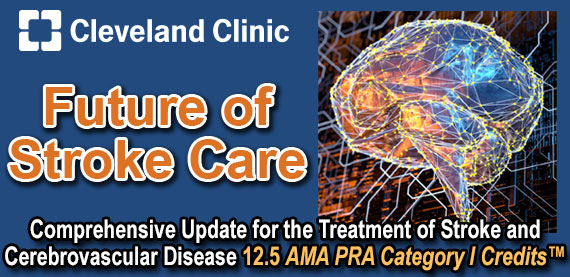
Meetings By Mail Cleveland Clinic Future of Stroke Care 2025
40 $
Format :42 videos + 1 pdf, size: 3.21 GB
Release date: December 22, 2025
Cleveland Clinic’s Future of Stroke Care provides a comprehensive exploration of cerebrovascular disease, and details the latest updates in management. An expert, multidisciplinary faculty focuses on improving patient outcomes through collaboration and integration of innovative practices in stroke care. Artificial intelligence’s role in stroke prevention and diagnoses is a key area of emphasis, with presentations designed to benefit all healthcare providers involved in treatment.
Topics include: Environmental factors in stroke risk, inflammation, brain-heart connection, PFO closure, atherosclerotic disease impact, GLP-1 receptor agonists, patient centered cerebrovascular care, neurocognitive impairments, thrombolysis, cerebral amyloid angiopathy, sleep apnea, advanced neurointerventional techniques, nursing, dysphagia, multimodal neurocritical care, neurostimulants and much more.
The Meetings By Mail: Cleveland Clinic Future of Stroke Care 2025 program is best for neurologists, neurosurgeons, neuroradiologists, emergency physicians, rehabilitation specialists, and advanced practice providers who want CME/CE‑accredited, expert‑led updates on the latest advances in stroke and cerebrovascular disease management. It is particularly valuable for clinicians who cannot attend in person but want flexible, on‑demand access to Cleveland Clinic’s multidisciplinary faculty.
Who Should Enroll
Neurologists & stroke specialists managing acute ischemic and hemorrhagic stroke.
Neurosurgeons & interventional neuroradiologists performing endovascular and surgical interventions.
Emergency physicians & intensivists involved in hyperacute stroke care.
Rehabilitation specialists & therapists focusing on post‑stroke recovery and outcomes.
Advanced practice providers (NPs, PAs) working in stroke units or neurocritical care.
Residents, fellows, and trainees in neurology, neurosurgery, or radiology seeking structured CME education.
What You’ll Learn
Latest stroke therapies: thrombolysis, thrombectomy, and evolving endovascular techniques.
Cerebrovascular disease updates: aneurysm, AVM, and carotid disease management.
Neuroimaging advances: CT perfusion, MRI, and AI‑assisted diagnostics.
Rehabilitation strategies: multidisciplinary approaches to maximize recovery.
Future directions: technology integration, tele‑stroke, and precision medicine in cerebrovascular care.
+ Topics:
Session 1: Evolving Landscapes in Cerebrovascular Disease
The Silent Threat: How Environmental Factors Shape Stroke Risk
Jukka Putaala, MD, PhD
Inflammation and Stroke Risk: The Next Frontier
Amre Nouh, MD
Minimally Invasive ICH Evacuation: The ENRICH and REACH Trials
Mark Bain, MD
Surgical Management of Brainstem Cavernoma: The Impact of White Mater Fiber Dissection
Badih Adada, MD
Questions & Answers
Session Faculty
Session 2: Beyond the Brain: The Brain-Heart Connection
LAA Closure: What’s Now and What’s Next?
Mauricio Cohen, MD
Patient Selection for PFO Closure: the Truth, the Hole Truth and Some Other Thoughts
David Thaler, MD, PhD
Cardioembolic Stroke Prevention, Beyond AFib and PFO
Jerry Estep, MD
Leveraging Artificial Intelligence for Secondary Stroke Prevention
David Z. Rose, MD
Questions & Answers
Session Faculty
Session 3: Precision Medicine: Atherosclerotic Disease in Stroke
Endovascular Management of Intracranial Atherosclerotic Disease
Syed Irteza Hussain, MD
Updates on Medical Management of Symptomatic Intracranial Atherosclerotic Disease
Jose Romano, MD
Asymptomatic Carotid Disease
Mubashir Pervez, MD
GLP-1 Receptor Agonists and Stroke Prevention
Alexandra Mikhael, MD
Questions & Answers
Session Faculty
Session 4: Patient Centered Cerebrovascular Care or Advancing CV Care
Beyond Time: Reinventing MR Imaging of Spinal AV Fistual
Avi Oppenheimer, MD
Translational Neurosurgery and Application in Cerebrovascular Care
Mauricio Mandel, MD
Stroke in the Young: Targeted Diagnostic Approaches
Sarah Lee, MD
Paired Vagal Nerve Stimulation Therapy for Stroke Patients
Oskar Szentirmai, MD
Questions & Answers
Session Faculty
Session 5: Future of Stroke Care in Practice
Neurocognitive Impairments After Stroke
Mark Todd PhD
A Story of Hope Here at Home
Marc Babi, MD
Stroke Case: BF
Mubashir Pervez, MD
Session 6: Breakthroughs in Stroke Care
Clocked Out: The Modern Age of Thrombolysis in AIS
Whitney Mayberry, MD
Cerebral Amyloid Angiopathy
Andrew Russman, DO
Sleep Permeates Everything: The Relationship Between Obstructive Sleep Apnea and Stroke
Christopher Deline, MD
Rewiring the Brain: Future of Post-Stroke Care
Ahmed Koriesh, MD
Questions & Answers
Session Faculty
Session 7: Advanced Neurointerventional Techniques: Challenging Clinical Cases
The Carotid Conundrum: Dilemmas in Detecting Arterial Occlusion
Michal Obrzut, MD
Challenging Stroke Intervention Cases
Gabor Toth, MD
Interventional Case Discussion
M. Shazam Hussain, MD
Carotid Chronic Total Occlusion
Ryan Dalgren, MD
Session 8: Beyond the Bedside
Refining the Basics to Redefine Stroke Outcomes
James Roach, DO
Nursing and the Future of Stroke Care
Kerry Major, MSN
Advances in Treating Dysphagia
Isabel Ramati, MS
Posterior Circulation Stroke: Locked in On the Latest Advances
Kristin Ogden, APRN
Intervention vs. Best Medical Management: Is It Worth It for the Posterior Circulation?
Alyssa Seldes, PA-C,
Questions & Answers
Session Faculty
Session 9: Neurocritical Care in Cerebrovascular Disease
Advanced Multimodal Monitoring in Neurocritical Care
Joao Gomes, MD
Complex Ethical and Legal Cases in Neuro Intensive Care
Marc Babi, MD
Neurostimulants in Stroke Recovery: Evidence, Efficacy and Emerging Practices
Grace M. Conroy, PharmD, BCCCP
Expanding Neurocritical Care in Developing World
Fouad Abuzeid, MD
Be the first to review “Meetings By Mail Cleveland Clinic Future of Stroke Care 2025”
You must be logged in to post a review.
Related products




Reviews
There are no reviews yet.