


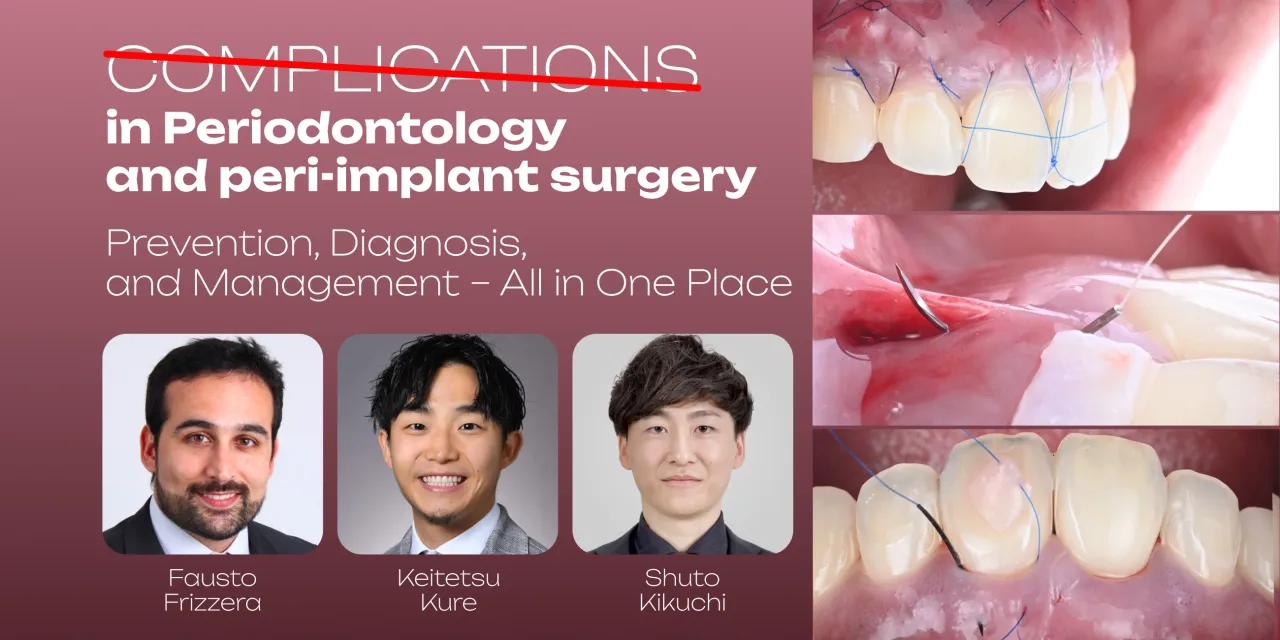
OHI-S Complications in Periodontology and Peri-implant Surgery Prevention, Diagnosis, and Management – All in One Place 5 lessons 4h 33min
45 $
Format : Videos + PDF
Complications in periodontology and peri-implant surgery are no longer viewed as isolated adverse events, but as structured biological responses that can be analyzed, classified, and systematically managed. This course builds a unified clinical framework that integrates soft tissue breakdown, peri-implant disease progression, and regenerative failure into a single decision-making pathway. It focuses on prevention, diagnostic accuracy, and stepwise treatment planning to transform complications into predictable, treatable conditions.
Learning Objectives
Systematically diagnose and classify peri-implant soft tissue defects, including volume loss, recession, and papilla deficiencies.
Implement evidence-based prevention and management of soft tissue complications around dental implants.
Apply contemporary surgical approaches for peri-implantitis, including decontamination and defect-driven decision-making.
Execute regenerative and resective strategies for peri-implant bone loss and surgical complications.
Analyze and troubleshoot Guided Bone Regeneration (GBR) failures using secondary reconstruction protocols.
Perform microsurgical approaches to mucogingival reconstruction, including tunneling techniques and connective tissue grafting protocols.
Develop long-term maintenance strategies to improve clinical stability and reduce the recurrence of complications.
Target Audience
This course is intended for dental professionals who manage complex periodontal and peri-implant soft and hard tissue complications, focusing on advanced diagnosis, surgical intervention, and regeneration.
Best for Periodontists, Implantologists, Oral and Maxillofacial Surgeons, and Restorative Dentists.
Topics
Lesson 1. Peri-Implant Soft Tissue Defects: Diagnosis and Complications
Clinical diagnosis of peri-implant soft tissue defects
Assessment of soft tissue volume loss
Peri-implant soft tissue recession
Loss of interproximal papilla and esthetic compromise
Surgical technique-related complications
Prosthetic-driven soft tissue alterations
Prevention of esthetic failures around implants
Lesson 2. Management of Soft Tissue Complications Around Dental Implants: Prevention, Diagnosis, and Treatment
Diagnosis and classification of peri-implant soft tissue alterations
Prevention of soft tissue complications in esthetic implant sites
Clinical decision-making: treatment indications, timing, and prognosis
Peri-implant plastic surgery techniques for soft tissue reconstruction
Implant removal, site preservation, and soft tissue reconstruction following implant failure
Lesson 3. Surgical Management of Peri-Implantitis: Contemporary Approaches to Implant Complications
Clinical and radiographic diagnosis of peri-implantitis
Implant surface decontamination techniques
Classification and management of peri-implant bone defects
Regenerative surgical approaches for peri-implantitis
Resective surgical procedures and clinical indications
Long-term maintenance protocols and supportive peri-implant therapy
Lesson 4. Root Coverage and Papilla Reconstruction: Advanced Surgical Techniques and Clinical Protocols
Classification of gingival recessions: Miller and Cairo system
Clinical diagnosis and treatment planning for root coverage procedures
Incision design, flap elevation, and microsurgical suturing principles
Management of suprabony and intrabony periodontal defects
Partial-thickness and split-full-split (mixed-thickness) flap techniques
Supracrestal (supra-alveolar) periodontal tissue reconstruction protocols
Interproximal tunneling with customized connective tissue grafts
Connective tissue graft (CTG) techniques for papilla reconstruction
Microsurgical suturing techniques: interrupted interproximal sling and double-crossed sutures
Prevention and management of complications in root coverage surgery
Step-by-step analysis of clinical cases and treatment outcomes
Lesson 5. Rethinking GBR Success: Managing Failures and Achieving Predictable Bone Regeneration
Biological principles of bone regeneration
Indications and objectives of GBR
Factors influencing predictable regenerative outcomes
Principles of wound healing and space maintenance
Aetiology of GBR failures:
Surgical factors: flap design, tension-free closure, membrane handling, and infection control
Patient-related risk factors: systemic conditions, smoking, oral hygiene, and compliance
Material-related factors: graft selection, membrane characteristics, stability, and fixation
Biological and mechanical causes of regenerative failure
Classification and diagnosis of GBR complications:
Early versus late complications
Partial versus complete graft loss
Soft tissue dehiscence and membrane exposure
Clinical and radiographic assessment of compromised regenerative sites
Review of representative GBR failure cases
Identification of surgical errors and contributing risk factors
Clinical decision-making based on radiographic and intraoperative findings
Management of failed GBR procedures
Immediate versus delayed intervention strategies
Management of membrane exposure and infection
Secondary grafting techniques and site reconstruction
Criteria for retreatment and achieving predictable outcomes
Prevention and long-term success
Be the first to review “OHI-S Complications in Periodontology and Peri-implant Surgery Prevention, Diagnosis, and Management – All in One Place 5 lessons 4h 33min”
You must be logged in to post a review.
Related products

Reviews
There are no reviews yet.