

The Periorbital Atlas: Eyes, Brow & Lid Lift (Surgical Mastery Series Vol. 03) (PDF)
15 $
Format: Publisher PDF
File Size : 282.1
VOL. 03 Premium Digital Atlas
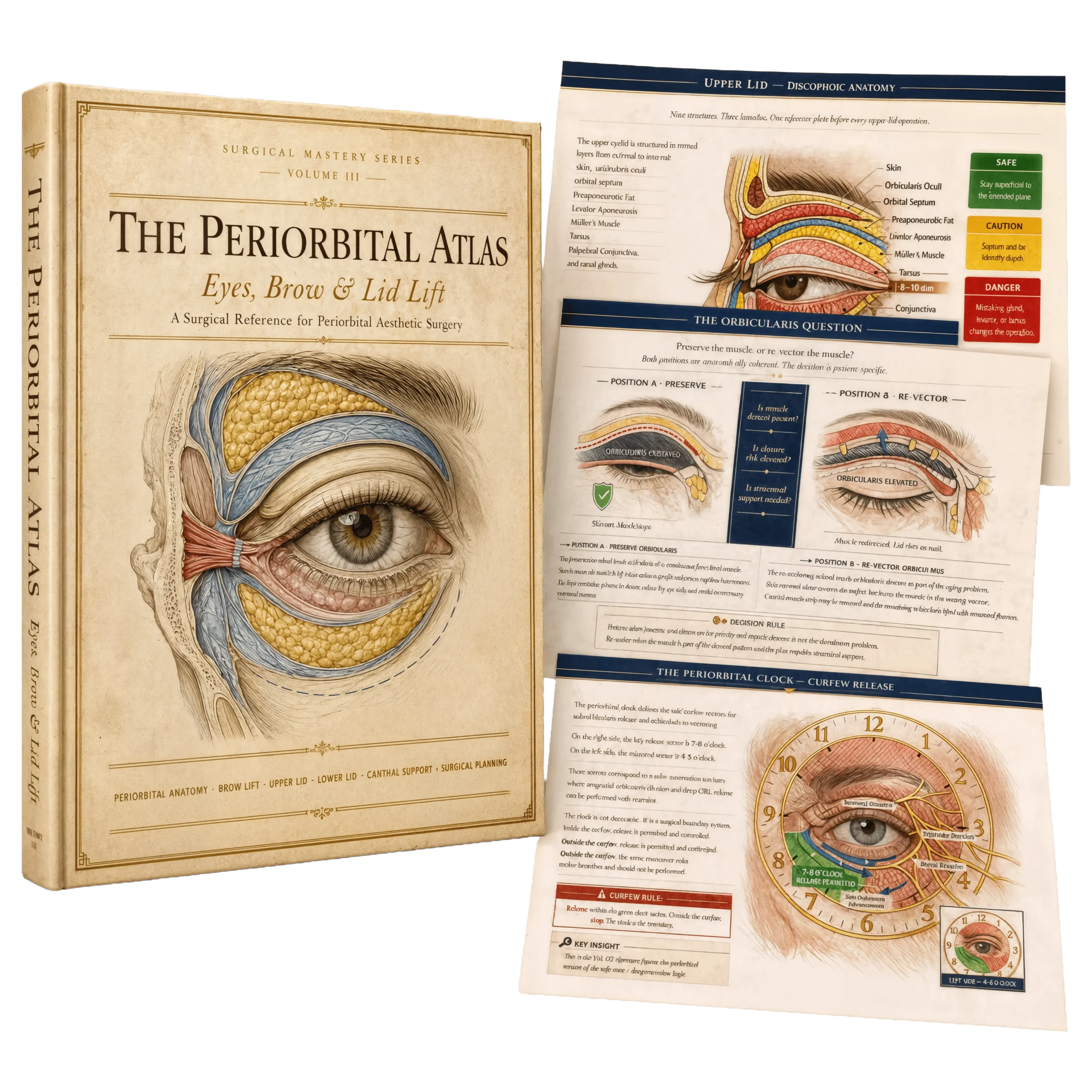
THE PERIORBITAL ATLAS: Eyes, brow & lid lift — one continuous aesthetic unit.
A 120-page surgical reference for periorbital aesthetic surgery, distilled from six faculty voices across two days of cadaver-laboratory teaching. Four anatomic territories, five decision frameworks, and 88 verbatim faculty pearls — disagreement preserved as a tool, not reconciled away.
Four Parts: upper lid · brow · lower lid · lip lift
The periorbital clock — safe sub-orbicularis curfews
88 role-coded pearls · 28 peer-reviewed citations
Instant access · Read in clinic, study anywhere
What this atlas helps you do
The smallest aesthetic unit on the face — and the least margin for error
Read the whole unit
See the brow, lids, canthus, and lip as one continuous aesthetic territory — not five separate complaints.
Apply the 90-90 rule
Recognize when brow descent — not eyelid skin — is the true cause of the hooding the patient describes.
Set the curfews
Use the periorbital clock to define exactly where sub-orbicularis release is safe — and where it isn’t.
Carry the disagreement
Hold both faculty schools in mind as a decision framework — preservation versus re-vectoring, transconj versus transcut.
Inside the atlas
Foundational anatomy. Contested decisions. Surgical technique. Pearls.
01
The Five Decision Points
Five contested decisions organize the volume — each preserved as a decision framework, not resolved into consensus. Brow before bleph? Transconjunctival or transcutaneous? Preservation or re-vectoring? Each decision is downstream of every prior one.
02
The 90-90 Rule
In a 400-patient consecutive series, more than 90% of patients presenting for blepharoplasty had hooding caused by brow descent — not eyelid skin excess. The eyelids are bystanders. The diagnostic is the two-finger elevation test, and the shape change is V-to-C, not height.
03
Discophic Anatomy, Every Part
Each Part opens with the reference figure the surgeon returns to before every operation: nine labeled upper-lid layers, the five forehead layers and Pitanguy’s line, the three lower-lid lamellae, and the lip’s vermilion architecture. Danger structures flagged — the trochlea, the frontal branch, the tear pump.
04
Frameworks, Timing & Consent
The back matter ties the four Parts together: five composite decision frameworks, a cross-procedure timing matrix for combined operations under one anesthetic, a universal consent architecture, and a 90-day recognition timeline for spotting complications early.
The four anatomic parts
One periorbital unit, four operations
Each Part follows the same editorial grammar: foundational anatomy, the most contested faculty decision on a dialectic page, surgical technique, decision framework, pearls, and a pitfalls + warnings spread.
Ⅰ – Upper Lid Blepharoplasty
Ⅱ – Brow Lift
Ⅲ – Lower Lid
Ⅳ – Lip Lif
Who it’s for
Facial plastic, oculoplastic, and aesthetic surgeons
Fellows and senior residents preparing for periorbital cases
Surgeons adding brow, canthal, or lip-lift work to their bleph practice
Anatomy-focused educators teaching periorbital technique
Owners of Vol. 01 extending the curfew grammar to the eye
Be the first to review “The Periorbital Atlas: Eyes, Brow & Lid Lift (Surgical Mastery Series Vol. 03) (PDF)”
You must be logged in to post a review.
Related products



Reviews
There are no reviews yet.