

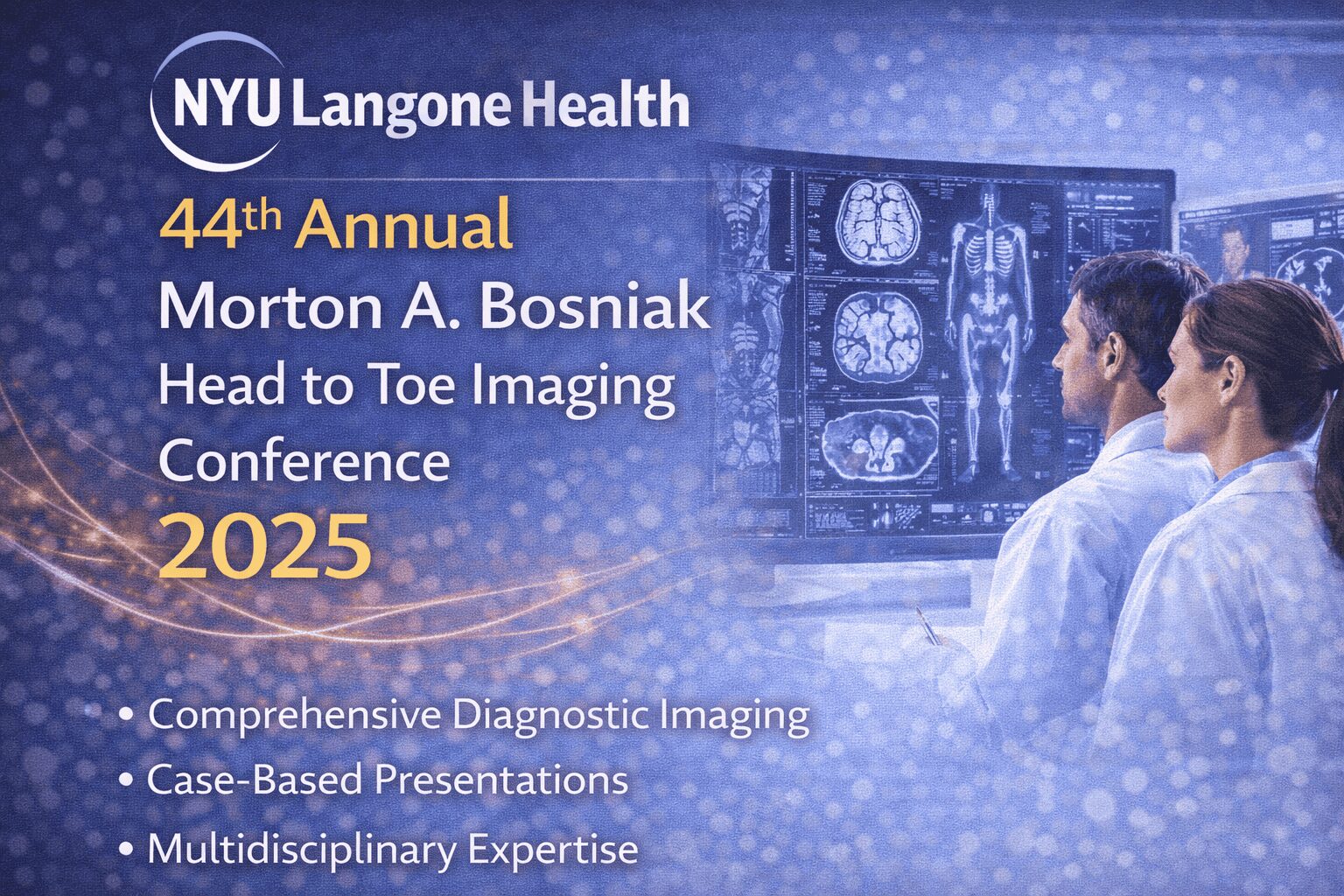
NYU Langone Health 44th Annual Morton A. Bosniak Head to Toe Imaging Conference 2025
75 $
Format :81 Videos (.mp4)+ 81 Subtitles (.vtt) + 64 PDFs, size: 25.01 GB
1. Overview
The NYU Langone Health 44th Annual Morton A. Bosniak Head to Toe Imaging Conference 2025 provides an intensive, comprehensive review of current diagnostic imaging practices. The course covers the latest advancements across subspecialties, including thoracic, cardiac, breast, abdominal, neuro, and musculoskeletal imaging, emphasizing the integration of artificial intelligence and updated reporting systems to optimize patient care.
Course Date: December 15, 2025 7:00 AM – December 19, 2025 6:00 PM
The 44th Annual Morton A. Bosniak Head to Toe Imaging Conference offers an intensive 5-day program reviewing Neurologic, Musculoskeletal, Pediatric, Abdominal, Thoracic, Cardiac, Breast, Emergency, PET/CT, Nuclear, and Interventional Radiology. Its continued focus on safety and quality issues, and radiology applications of artificial intelligence, crosses all sub-specialty areas. Due to tremendous growth in the science of imaging and practice of radiology, it is imperative that radiologists continually update their skills and gain exposure to advances in the field. Maintenance of certification requires continued review and adoption of essential and cutting-edge imaging techniques in all modalities, covering the entire body. Comparative effectiveness research as it applies to imaging is incorporated throughout the course, allowing immediate application to clinical practice, with an eye towards quality, safety, best practices, and the trend towards ‘accountable care organizations’. Utilization of standardized imaging strategies, developed by collaborative teams of imagers and clinicians attentive to safety, quality and economic imperatives, is a growing trend that will be emphasized, supporting the field’s imperative for integration of clinical decision support. The course is designed to examine the practical aspects of established CT, MR, US, PET and Interventional techniques, as well as to introduce new techniques and applications for these modalities. Plenary sessions are structured to review pathologic processes and image interpretation and to update the registrant on advanced applications and image analysis. Based on learner’s feedback, and the proven effectiveness of ‘case-based’ learning, heavily case-based sessions will be integrated throughout the program. An innovative feature of this course is that individual sections of the program can be attended on a daily basis, allowing course content to be tailored to the unique interests and requirements of each registrant. The purpose of this course is to provide the registrant with an overview of state-of-the-art imaging methods as they pertain to clinical practice and to introduce advances in the field in terms of imaging technology, and disease diagnosis and management.
2. Learning Objectives
After participating in this activity, clinicians should be able to:
Evaluate and incorporate current imaging techniques and protocols for subspecialty imaging (Abdominal, Musculoskeletal, Neurologic, Thoracic, Cardiac, Breast, PET/CT, Emergency Medicine, and Interventional) into clinical practice to enable accurate diagnosis, dictate best therapy options, and assess response to therapy, which may prompt therapy modification as needed
Describe the practical tips and advantages of using photon-counting CT for the evaluation of abdominopelvic tumors
Analyze HRCT images of patients with ILD and more accurately differentiate fibrotic and non-fibrotic HP from other ILDs
Describe a spectrum of common and less common manifestations of vascular emergencies in the chest, abdomen, pelvis, and extremities on cross-sectional imaging examinations
Describe the radiographic characteristics of ARIA that occur with anti-amyloid therapy in patients with Alzheimer’s disease
3. Target Audience
Best for radiologists and imaging specialists who want updates on head-to-toe imaging techniques, AI integration, and diagnostic guidelines.
The program is designed for clinical radiologists in either general or specialized practice, and is appropriate for radiologists in training. Familiarity with the fundamentals of CT, MR, PET, and US technology and applications, as well as basic anatomy, is assumed.
4. Topics
Pulmonary Artery CTA and Multi-Energy Imaging – Jane P. Ko, MD
The Challenging Acute Aorta – Smita Patel, MBBS, MRCP, FRCR
Coronary Arteries – Beyond Atherosclerosis – Smita Patel, MBBS, MRCP, FRCR
Cardiac Pathology Identified in Non-Cardiac Non-Gated Studies – Panagiota Christia, MD
Q and A Session – Faculty
Cardiac Valvular Disease – Kana Fujikura, MD, MPH
Challenging Cardiac CT Cases – Jill E. Jacobs, MD
Evaluation of Cardiac Function – Leon Axel, MD, PhD
Q and A Session – Faculty
Lung Cancer Screening – Dexter P. Mendoza, MD
Imaging of Lung Cancer – Charlotte Charbel, MD
Primary and Metastatic Lung Tumor Interventions – Nathan K. Mickinac, MD
Q and A Session – Faculty
Chest MR – William H. Moore, MD
Esophageal Emergencies – Gene Y. Berkovich, MD
ICU Plain Film – Jadranka Stojanovska, MD
Q and A Session – Faculty
Method of Detection of Breast Cancer, the New Biomarker – Jean M. Seely, MD
Update on Management of BBD with a Focus on High-Risk Lesions – Samantha L. Heller, MD, PhD
AI in Breast Imaging – Jean M. Seely, MD
Tumor Board for the Radiologist – Beatriu Reig, MD, MPH
Updates on ACR Appropriateness Criteria for Screening – Alana Lewin, MD
Q and A Session – Faculty
CEM and MRI – Strengths, Limitations, and Synergies – Michelle Lee, MD
Auditing Breast MRI – Jean M. Seely, MD
Breast MRI Safety – Julia Po, MD
Latest and Greatest in Breast Imaging You Can Use – Linda Moy, MD
Q and A Session – Faculty
De-Mystifying the Mesentery – Myles Taffel, MD
Ovarian Imaging – Current Approaches and Advances – Kira Melamud, MD, MHPE
Abdominal Ultrasound – Pearls and Pitfalls – Daniel T. Parrott, MD
Easy to Fly By Incidental Critical Findings in Body Imaging – Jay Karajgikar, MD
Best Body Club Cases of The Year – Sarah R. Beier
Q and A Session – Faculty
Pancreatic Cyst Imaging and Evolving Guidelines – Chenchan Huang, MD
Pancreatic Neuroendocrine Tumor – Updates in Imaging and Management – Linda Chu, MD
DOTA-peptide PET – Essentials and Challenges – Marius E. Mayerhoefer, MD, PhD
AI in Body Imaging – Where Are We Now – Linda Chu, MD
Q and A Session – Faculty
Liver Imaging – LI-RADS and Beyond – Krishna P. Shanbhogue, MD
Liver Tumor Ablation – A Review of Standard and Emerging Technologies – Mikhail Silk, MD
Rad-Path Discordance in Prostate MRI- Impact of Image Quality – Angela Tong, MD
Q and A Session – Faculty
Renal Masses -Updates and the Role of KI-RADS – Nicole M. Hindman, MD
Pitfalls of Bowel Interpretation on Routine Abdominal and Pelvic CT – Douglas S. Katz, MD, FACR, FASER, FSAR
Pediatric Emergency Abdominal Imaging – Naomi A. Strubel, MD
Q and A Session – Faculty
Stroke Code – Challenging Cases and Lessons Learned – Evan G. Stein, MD, PhD
Brain Tumor Basics in the Molecular Era – Roshni R. Patel, DO
Susceptibility Weighted Imaging – My Favorite Sequence After DWI – Rajan Jain, MD
Spinal CSF Leak – What the Radiologist Needs to Know – Peter G. Kranz, MD
Q and A Session – Faculty
Case Based Neuroanatomy – Andrew C. McClelland, MD, PhD
Not Futile Anymore – Imaging of Alzheimers Disease in the Era of Disease Modifying Therapy – James R. Loftus, MD
Imaging of the Post-Operative Spine (Made Easy) – Peter G. Kranz, MD
Q and A Session – Faculty
Fractures of Child Abuse – What the Radiologist Needs to Know – Shailee V. Lala, MD
Abusive Head Trauma – Brain to Bones – Imaging Insights in Suspected Child Abuse – Kevin Hsu, MD
Head and Neck Emergencies – Mari Hagiwara, MD
Dotatate PET in Neuroradiology – Meningiomas and Paragangliomas – Kent P. Friedman, MD
Q and A Session – Faculty
Upper Aerodigestive Tract Made Easy – Gopi K. Nayak, MD
Navigating Complex Facial Trauma – Matthew S. Breen, MD
Neuro Jeopardy – Test Your Knowledge – Evan Lieberman, MD
Q and A Session – Faculty
Classification Systems for Soft Tissue Tumors – How To Incorporate Into Practice – Hillary Garner, MD
Knee Chondral Joint-Preserving Surgical Options- MRI Assessment – Erin Alaia, MD
Imaging of Musculoskeletal Interventions – An update Using a Case-based Approach – Christopher J. Burke, MD
Muscle Injuries – Iman Khodarahmi, MD, PhD
Q and A Session – Faculty
High Water Content Soft Tissue Masses – Hillary Garner, MD
Spinal Trauma – Key Issues in the Emergent Setting – David Y. Kim, MD
Musculoskeletal Manifestations of Cancer and Treatment-Related Conditions – Anton Becker, MD, PhD
Q and A Session – Faculty
Vascular Anomalies – Diagnostic Imaging and Interventional Approaches – Frederic J. Bertino, MD and Alexander El-Ali
Imaging of Arthroplasties – Meghan Jardon Zikaras, MD
Q and A Session – Faculty
Get Hip to It – Pelvis and Hip Cases – Dana Lin, MD
Hand and Wrist Challenging Cases – Sophie L. Leung, MD
Foot and Ankle Challenging Cases – Alexandra Napolitano, MD
Q and A Session – Faculty
Be the first to review “NYU Langone Health 44th Annual Morton A. Bosniak Head to Toe Imaging Conference 2025”
You must be logged in to post a review.
Related products





Reviews
There are no reviews yet.