

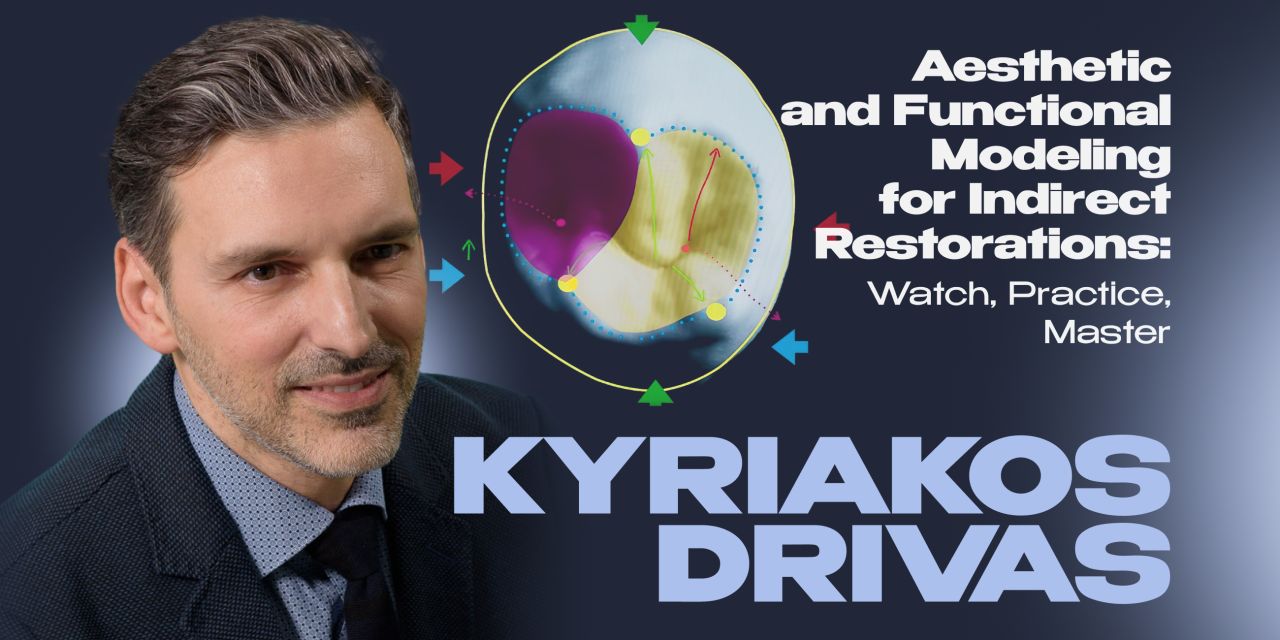
OHI-S Aesthetic and Functional Tooth Morphology Carving Watch, Practice, Master
60 $
Format : 8 videos + 8 audios + 8 file sub vtt, size: 6.8 GB
8 lessons (4h 36min)
Deepen your understanding of dental aesthetics, tooth anatomy, and morphology with carving techniques in a course designed for you to Watch, Practice, and Master!
Kyriakos Drivas is an instructor in veneering materials and an expert in all-ceramic systems, with 30 years of experience as a dental technician.
During the course, you will learn about:
– Protocols for carving anterior and posterior teeth of the upper and lower jaw
– Tips and tricks for achieving natural-like tooth morphology
– Solutions to all the nuances of aesthetics, occlusion, functionality, and biology for predictable indirect restorations.
This course is for all specialists interested in learning and perfecting the carving of dental anatomy and morphology, including dental technicians, prosthodontists, restorative dentists, and dental students.
The OHI‑S Aesthetic and Functional Tooth Morphology Carving: Watch, Practice, Master course is best for dental students, general dentists, prosthodontists, and dental technicians who want structured, training in tooth morphology and carving techniques to achieve functional and aesthetic restorations.
Who Should Enroll
Dental students & trainees learning foundational tooth anatomy and carving skills.
General dentists refining their ability to replicate natural tooth morphology in restorative work.
Prosthodontists ensuring functional occlusion and aesthetics in complex restorative cases.
Dental technicians & lab professionals mastering wax‑up and carving for crowns, veneers, and prosthetics.
Residents & fellows in restorative dentistry or prosthodontics seeking structured practice modules.
What You’ll Learn
Tooth morphology fundamentals: anatomy, proportions, and functional occlusion.
Carving protocols: step‑by‑step guidance for wax‑up and direct carving exercises.
Functional integration: ensuring restorations harmonize with occlusion and jaw movement.
Aesthetic replication: contouring, surface texture, and natural tooth appearance.
Practice modules: “Watch, Practice, Master” format for progressive skill development.
Case‑based lessons: clinical examples showing how morphology impacts function and aesthetics.
+ Topics:
Lesson 1.Achieving Natural Aesthetics in Upper Anterior Teeth
– Analysis of the central incisor, lateral incisor, and canine:
– Individual characteristics and their contribution to the smile
– Proportions and positioning in relation to facial aesthetics.
– Tips for achieving a natural result:
– Key elements that enhance realism in restorations.
– Observing natural patterns:
– Understanding natural tooth morphology
– Identifying common variations and applying them in practice.
Recommended for: Prosthodontists, Dental technicians.
Lesson 2.Carving the Anatomical Functionality of Upper Anterior Teeth
– The architectural relationship between anterior teeth:
– How central incisors, lateral incisors, and canines interact
– Balancing width, height, and contour for harmony
– The role of anterior teeth in functionality:
– Importance in phonetics and occlusion
– Impact on overall dental health and longevity of restorations.
– Avoiding absolute symmetry to achieve harmony:
– The concept of natural asymmetry in aesthetics
– Techniques to create a lifelike and pleasing smile.
Recommended for: Prosthodontists, Dental technicians.
Lesson 3.Designing Aesthetic Harmony in Mandibular Anterior Teeth
– Analysis of the central incisor, lateral incisor, and canine in the lower jaw
– The role of mandibular anterior teeth in occlusion
– Comparative analysis: mandibular vs. maxillary anterior teeth.
Recommended for: Prosthodontists, Dental technicians.
Lesson 4.Mandibular Anterior Teeth: Occlusion, Aesthetics and Functional Balance
– Key techniques for achieving a natural aesthetic restorations
– Optimal axial inclinations and heights of mandibular anterior teeth
– Tips for achieving a natural result: Key elements that enhance realism in restorations.
Recommended for: Prosthodontists, Dental technicians.
Lesson 5.Posterior Occlusion in the Maxilla: Shaping Natural Anatomy
– Analysis of the 1st and 2nd premolars, and 1st and 2nd molars in the upper jaw
– Position of posterior teeth and their appearance within the dental arch
– Evaluation and understanding of planes and curves in posterior occlusion.
Recommended for: Prosthodontists, Dental technicians.
Lesson 6.Carving the Functional Posterior Occlusion in the Maxilla
– Axial gradients and their role in absorbing bite forces
– Key occlusal contacts for functional stability
– Evaluation test: Distinguishing the first premolar from the second premolar.
Recommended for: Prosthodontists, Dental technicians.
Lesson 7.Posterior Occlusion in the Mandible: Anatomy and Functional Dynamics
– Analysis of the 1st and 2nd premolars, 1st and 2nd molars in the lower jaw
– Evaluation and understanding of planes and curves in mandibular occlusion
– The role of mandibular teeth in occlusion and functional dynamics.
Recommended for: Prosthodontists, Dental technicians.
Lesson 8.Contact Point and Posterior Occlusion in the Mandible
– Key differences between upper and lower posterior teeth
– Small anatomical details that influence clinical perspective
– The impact of tooth inclination on occlusal function
– Identifying wear patterns and their significance in diagnosis.
Recommended for: Prosthodontists, Dental technicians.
Be the first to review “OHI-S Aesthetic and Functional Tooth Morphology Carving Watch, Practice, Master”
You must be logged in to post a review.
Related products


Reviews
There are no reviews yet.