

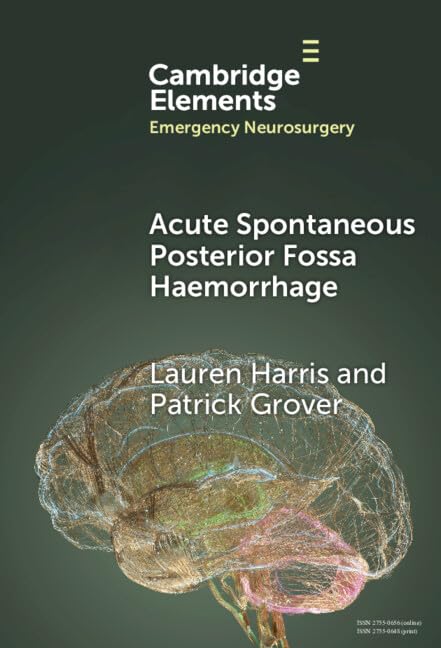
Acute Spontaneous Posterior Fossa Haemorrhage (Elements in Emergency Neurosurgery) (PDF)
8 $
Format: Publisher PDF
File Size : 2.8
Publisher: Cambridge University Press
By Lauren Harris, Patrick Grover
Non-traumatic posterior fossa haemorrhage accounts for approximately 10% of all intracranial haematomas, and 1.5% of all strokes. In the posterior fossa, a small amount of mass effect can have dramatic effects, due to its small volume. This can be due to immediate transmission of pressure to the brainstem, or via occlusion of the aqueduct of Sylvius or compression of the fourth ventricle, leading to acute obstructive hydrocephalus, with the risk of tonsillar herniation. Timely investigations and management are essential to maximise good outcomes. This Element offers a brief overview of posterior fossa haemorrhage. It looks at the anatomy, aetiology, management, and surgical options, with a review of the available evidence to guide practice.
Product details
Publisher : Cambridge University Press
Publication date : February 29, 2024
Edition : 1st
Language : English
Print length : 26 pages
ISBN-10 : 1009456482
ISBN-13 : 978-1009456487
Be the first to review “Acute Spontaneous Posterior Fossa Haemorrhage (Elements in Emergency Neurosurgery) (PDF)”
You must be logged in to post a review.
Related products


Reviews
There are no reviews yet.